
A growing tuition network eventually outgrows generic class-management tools, but not every network should build its own platform. Below a size threshold, off-the-shelf software wins on cost and speed. Above it, two things flip. Your operating model, the mastery approach, the parent experience, and often a franchise structure: that combination is exactly what generic software cannot express. And per-centre licence costs start to outweigh the cost of an owned platform. This guide sets out the signs you have outgrown your system, the build-vs-buy framework with honest thresholds, the licence-economics crossover, and what migrating a live multi-centre network actually involves. Building the owned platform is our bespoke franchise platforms work.
The timeframes in this guide reflect AI-augmented practices as of early 2026. AI tooling is advancing rapidly, and these timelines are compressing quarter by quarter. Treat specific figures as a reasonable upper bound rather than fixed estimates. Book a consultation for current timelines tailored to your situation.
When has a tuition network outgrown its system?
A tuition network has outgrown its system when the software has become a reason things are harder rather than easier. Early on, generic class-management software is a gift: it handles bookings, registers, and payments out of the box, and it is far cheaper than building anything. The problems start when the network grows past the shape the tool assumes.
The signs are consistent across networks, and none of them require naming a vendor to describe:
- Staff are the integration layer. People rekey data between systems, reconcile billing by hand, and maintain spreadsheets alongside the software because it does not quite fit. Effort scales with headcount instead of falling with it.
- The operating model is fought, not supported. Term structures, sibling discounts, holiday pauses, mastery tracking, or franchise reporting all need workarounds because the tool was built for a different shape of business.
- The parent experience is stuck. Parents expect app-quality booking, progress visibility, and communication, and the portal you can offer is a decade behind what they use everywhere else.
- Per-centre costs keep climbing. Every new centre adds licence fees, and the total has quietly become a large recurring line that grows with success.
One or two of these is normal. All of them together, especially with per-centre costs rising, is the signal that the category itself no longer fits.
Should you build or buy at network scale?
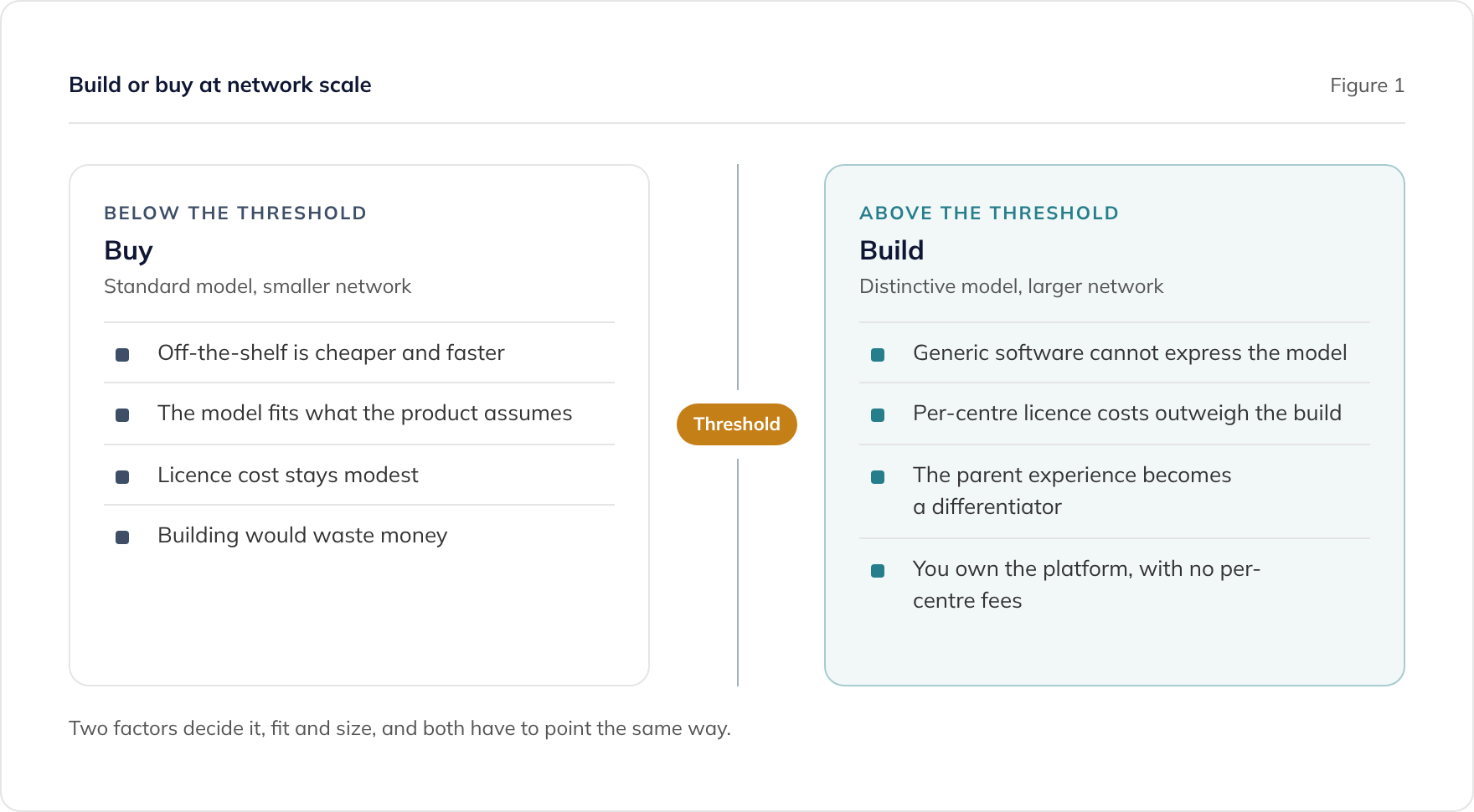
The honest framework has a threshold in it. Below a certain size, buy. Above it, and only when your operating model is genuinely distinctive, building becomes the better choice. Anyone who tells you to always build is selling, and the same is true of anyone who says never.
Two factors decide it, and both have to point the same way:
- Fit. How far your operating model diverges from what standard products assume. A network whose model is close to the mainstream should buy. A network whose mastery approach, parent experience, and franchise structure are central to how it competes is trying to express something generic software structurally cannot.
- Size. How many centres, members, and transactions the economics run across. Bespoke software is a one-off cost; subscriptions are a recurring cost that scales with the network. The larger the network, the more the recurring cost dominates.
The trap is treating these separately. A small network with an unusual model should still usually buy, because the size cannot justify the build. A large network with a standard model might reasonably keep buying, because the fit is fine. It is the combination, a distinctive model at scale, that makes building the rational choice. Our broader build vs buy in the age of AI-augmented development guide covers the general version of this decision.
The decision so far is about operations: the software that runs your centres. If your product strategy also involves the learning experience itself, that is a separate build with decisions of its own. It helps to understand how adaptive learning platforms actually work, how to structure the learning content library that sits underneath one, and how to keep AI tutoring safe for children, before you fold any of it into scope.
Where does the licence-economics crossover happen?
The crossover is the point where the recurring cost of per-centre or per-member licences overtakes the one-off cost of owning a platform. It is the financial heart of the decision, and it moves in favour of building as the network grows.
Off-the-shelf software is usually priced per centre, per user, or per member, so the bill rises every time you succeed. A bespoke platform is a one-off build plus ongoing support and hosting, with no per-centre fee. Early on, the subscription is cheaper. As the network grows, the subscription keeps climbing while the owned platform does not, and at some size the lines cross. Beyond that point, every new centre on the owned platform is close to free, while every new centre on a subscription adds cost forever.
Two of our guides go deeper on this economics:
- Own vs rent: perpetual licence vs per-member SaaS sets out the total-cost-of-ownership comparison for multi-site and membership operators.
- How to choose franchise software and franchise management vs operations software cover the franchise-specific version, where per-franchisee fees make the crossover arrive sooner.
AI-augmented development has moved the crossover earlier than it used to be, because it has reduced what a bespoke build costs. A decision that only made sense for very large networks a few years ago is now rational at smaller scale, which is worth revisiting if you last looked at this before AI changed the delivery economics.
What does migrating a live multi-centre network involve?
Migration is the part that frightens operators, and rightly, because you are changing the engine while the network keeps running. It is manageable, but only with a plan built around the realities of a live tuition business.
Cut over at a term boundary
Tuition runs on a term calendar. Bookings, registers, and billing all cycle around terms, so the natural moment to switch is between terms, when sessions are not in flight and the billing cycle has closed. Planning the cutover around the calendar, rather than a fixed launch date, avoids disrupting live delivery.
Run in parallel before you rely on it
Run the old and new systems alongside each other for a period, so you can verify the new platform against the one you trust before you depend on it. Parallel running is how you catch the discrepancies that only appear with real data, without betting the network on a clean switch.
Manage franchisee change, not just data
In a franchised network, the technical migration is only half the job. Each centre is run by people whose day gets harder if the change is handled badly, and adoption depends on them. Onboarding franchisees, training staff, and sequencing centres so the confident ones go first and prove the path is as important as the data migration itself. For recurring collection during and after the move, our work on moving from card billing to Direct Debit and the billing engine accelerator covers keeping term-fee collection reliable through the transition.
Deliver incrementally rather than as one launch. Getting parts of the platform into use before the whole is complete reduces risk and builds confidence, and it means value arrives sooner.
What does bespoke tuition software cost?
Bespoke tuition software is a one-off build cost plus ongoing support and hosting, not a subscription that grows with your network. That shape is the point: you pay to build it once and own it, rather than renting it per centre forever. The build cost is driven by scope, and it is delivered incrementally so cost tracks the value you turn on.
Two things shape the number. Scope, because a platform that covers bookings, billing, a parent app, and a franchise layer is more than one that covers bookings alone. And delivery efficiency, because AI-augmented development has reduced what a given scope costs to build compared with a few years ago, which is part of why the crossover has moved earlier. We build on a perpetual source code licence with no per-centre fees, so the ongoing cost is support and hosting rather than a scaling subscription. Exact figures depend on your scope and are best worked out together.
Where to start
Start by testing yourself against the framework honestly. Are the signs of outgrowing your system all present, is your operating model genuinely distinctive, and is the network large enough that the licence economics have crossed over? If the answer to all three is yes, replacement is a rational decision rather than a leap. If not, buying is still the right call, and that is a useful answer too.
We build owned platforms for tuition networks that have outgrown generic software, with the sector experience to understand the model and the AI-augmented delivery to build it efficiently. See our tutoring and supplementary education work and our bespoke franchise platforms service, or book a consultation for a straight assessment of whether your network has genuinely outgrown its system. No pitch, no obligation.
Frequently asked questions
When should a tuition business build its own platform?
What does bespoke tuition software cost?
How do I migrate centres to a new system without disruption?
Is off-the-shelf tutoring software ever the right choice?
How long does it take to replace a tuition management system?
Related guides
SaaS to Custom Software Migration: A 90-Day Playbook
How to migrate from SaaS to custom software: getting your data out, running both in parallel, cutting over safely, and exiting the contract.
Build In-House with AI or Use a Development Partner? An Honest Decision Guide
AI coding tools make in-house builds genuinely viable. A balanced decision guide for CTOs: when to build with your own team, when a partner earns its fee, and how to compare total cost honestly.
How franchise payments and payouts should work
How a franchise network collects payments and pays its franchisees: connected accounts with Stripe Connect, Direct Debit, and who holds the funds and the risk.