
Genuine adaptive learning is an architecture, not a feature. Four components make it work: a structured item bank, a learner model that tracks mastery per skill, a sequencing engine that decides what comes next, and a feedback loop that turns responses into evidence. Most products marketed as adaptive are missing at least two of the four, which is why they behave like branching quizzes. This guide explains each component in plain English and the trade-offs in how you sequence. It also draws the honest boundary of where large language models help and where they should be kept away from the decision. Building one of these is our custom software development work in the education sector.
What makes learning genuinely adaptive?
Adaptivity is an architecture, not a single feature you switch on. A genuinely adaptive platform keeps a running estimate of what each learner has mastered, and uses that estimate to choose the most useful next thing for them to do. Everything else is branching dressed up.
The distinction matters commercially. Buyers cannot easily tell mastery-based sequencing from a quiz with a few if-this-then-that branches, and vendors know it. The test is simple: ask the product to show you its current estimate of a named learner’s mastery on a named skill. If it cannot, it is not modelling the learner, and it cannot be adapting to one.
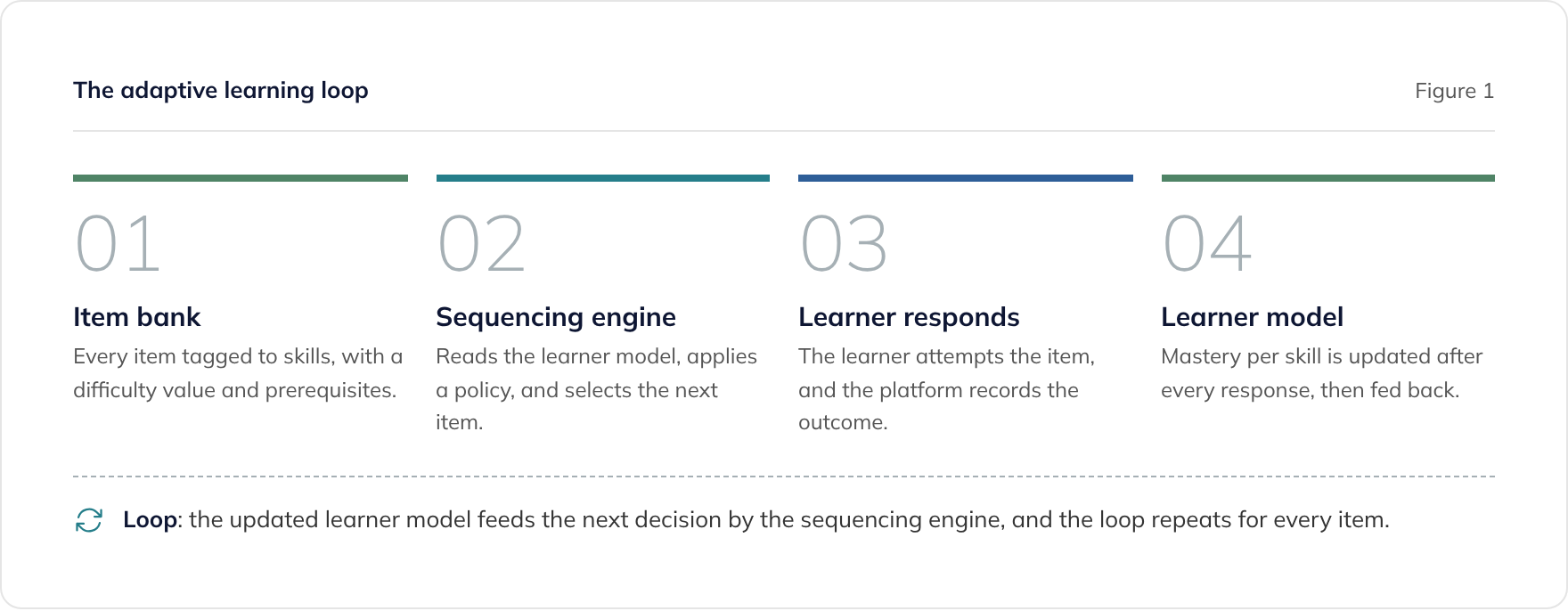
Four components have to be present and connected for the claim to hold:
- The item bank: the content, structured and tagged so the machine can reason about it.
- The learner model: a per-learner record of mastery, skill by skill.
- The sequencing engine: the policy that decides what to present next.
- The feedback loop: the mechanism that turns each response back into an updated model and, over time, into evidence.
Remove any one and the system stops being adaptive. Remove the item bank structure and the engine has nothing to reason over. Remove the learner model and there is no memory of what the learner knows. Remove the sequencing policy and you are back to a fixed path. Remove the feedback loop and the model never updates. The rest of this guide takes each in turn.
Why is the item bank the foundation everything stands on?
The item bank is where most adaptive projects succeed or fail, and it is the part buyers underestimate. An item is any question or activity a learner can attempt. For the engine to reason about it, each item needs structure the engine can read.
At a minimum, every item carries three pieces of metadata:
- Skill tags: which skill or skills the item assesses. This is the link between content and the learner model.
- Difficulty: how hard the item is, either estimated up front or calibrated from real response data.
- Prerequisites: implicitly, through the skill it maps to and that skill’s place in the skill graph.
Behind the items sits a skill graph. This records the skills your curriculum covers and, crucially, which skills depend on which. Long division depends on subtraction and multiplication. You cannot sensibly assess or teach the former before the latter are reasonably secure, and the skill graph is how the engine knows that.
This is unglamorous work. Most providers arrive with content trapped in worksheets, documents, and the heads of experienced tutors, none of which a machine can reason over. Turning that estate into a tagged, structured item bank is usually the longest part of the project, and it has to happen before any engine can adapt. We cover the method in detail in structuring a learning content library for adaptivity and AI.
How does a learner model track mastery in plain English?
The learner model is a per-learner record of how likely it is that the learner has mastered each skill. Think of it as a table with one row per skill and a number in each row that rises with evidence of success and falls with evidence of struggle. That number is the platform’s belief, updated after every response.
You do not need machine learning to build a good one. Two well-established, interpretable approaches cover most needs.
Item Response Theory
Item Response Theory (IRT) models the probability that a learner answers an item correctly as a function of the learner’s ability and the item’s difficulty. It gives you an ability estimate on a continuous scale, and it improves as items are calibrated against real response data. IRT is the backbone of most serious adaptive assessment, because it treats item difficulty and learner ability on the same scale.
Bayesian Knowledge Tracing
Bayesian Knowledge Tracing (BKT) models mastery of a skill as a hidden state that is either learned or not learned, and updates the probability of that state after each response. It handles the reality that learners slip on skills they know, and guess correctly on skills they do not. BKT is well suited to skill-by-skill mastery tracking in a tutoring context.
Both are transparent. You can explain to a teacher why the platform believes a learner has or has not mastered a skill, which matters enormously when a human is accountable for the child’s progress. Start with an interpretable statistical model. Add machine learning later, once you have data and a specific problem it solves, not as a starting assumption.
How does the sequencing engine decide what comes next?
The sequencing engine reads the current learner model, applies a policy, and selects the next item. The policy is a deliberate design decision, and different policies suit different products. There is no single correct answer, only trade-offs you should choose consciously.
Three common policies, and what each optimises for:
- Target the weakest evidence. Pick an item for the skill where the platform is least confident the learner has mastered it. This drives toward coverage and closes gaps, but can feel relentless if it always serves the hardest thing.
- Maximise information. Choose an item near the edge of the learner’s current ability, where the outcome tells you the most. This is efficient for assessment and converges on an accurate estimate quickly, but is less concerned with how it feels to learn.
- Enforce prerequisites. Never introduce a skill until its prerequisites in the skill graph are reasonably secure. This protects the learner from being thrown into content they cannot access, and usually sits on top of whichever selection policy you choose.
Most real platforms blend these, with guardrails. You might target weak skills, respect prerequisites, cap how many hard items appear in a row to protect motivation, and mix in review of previously mastered skills to counter forgetting. The blend is where product judgement lives, and it should be tunable rather than hard-coded, because different age groups and subjects behave differently.
Two failure modes are worth naming. An engine that only optimises for information can be demoralising, because it keeps a learner permanently at the edge of their ability where they fail often. An engine that only targets weak skills can trap a learner in remediation and never let them feel progress. Good sequencing balances accuracy, coverage, and motivation, and treats the last of these as a first-class concern.
Why does the feedback loop matter?
The feedback loop is what makes the system adaptive rather than static. Every response does two jobs: it updates the learner model for the next decision, and it accumulates into evidence about the learner, the item, and the platform as a whole.
At the learner level, the loop updates mastery estimates so the next item is chosen on current belief, not stale data. At the item level, aggregated responses let you recalibrate difficulty, spot items that behave badly, and retire items that no longer discriminate between learners who have and have not mastered the skill. At the platform level, the same data is the raw material for measuring efficacy.
A loop that only updates the learner and never feeds item calibration or efficacy measurement is a missed opportunity. Design the data capture so that every response is available for all three purposes from day one. Retrofitting analytics onto a platform that only stored the last state is expensive and lossy.
Where do large language models genuinely help, and where do they not?
This is the section that matters most, because it is where hype and reality diverge. Large language models (LLMs) are genuinely useful in an adaptive learning platform, but only in specific roles, and there are roles they should be kept out of.
Where LLMs help
- Content generation, with review. LLMs can draft items, distractors, worked solutions, and explanations far faster than authors working from scratch. Every generated item must pass human review before it enters the bank, but the acceleration is real and well evidenced in our own delivery, which we report quarter by quarter in the AI Velocity Report.
- Content enrichment. Suggesting skill tags, difficulty estimates, and prerequisite links across a large existing content estate is a strong fit, again with human sign-off. This is often the fastest way to structure a legacy library.
- Learner-facing feedback, constrained. An LLM can phrase a hint or explanation in age-appropriate language, provided it is constrained to the verified content of the item and its known solution, not generating facts freely.
Where LLMs do not help
- Unsupervised sequencing decisions. The choice of what a learner sees next should come from an interpretable model over the learner’s mastery, not from an LLM’s opinion. A statistical engine is explainable, auditable, and stable. An LLM asked to pick the next item is none of those, and cannot justify its choice to a teacher.
- Being the source of truth for facts in front of a child. LLMs hallucinate. A model that invents a plausible but wrong mathematical fact, presented to a nine-year-old as authoritative, is a safeguarding and reputational problem, not a rough edge. Facts a child sees must come from verified content, not free generation.
- Judging mastery. Whether a learner has mastered a skill is a measurement question with established methods. An LLM’s holistic guess is not a substitute for a calibrated model, and it removes the audit trail that accountability requires.
The honest summary: use LLMs to make content and to phrase feedback, both under human review, and use interpretable models to decide and to measure. Where a child could be harmed by a confident wrong answer, keep the LLM constrained to verified material. We treat this boundary in depth in AI tutoring for children: safety by design.
How do you measure whether adaptivity actually works?
Efficacy is measured in learning outcomes, not engagement. Time on task, streaks, and sessions completed tell you the product is sticky. They do not tell you a child learned more than they would have otherwise, and increasingly parents and schools ask for the second thing.
Design for evidence from the start:
- Track mastery growth per skill over time. The core signal is that learners move from not mastered to mastered across the skill graph, and that the rate is credible.
- Compare against a baseline. Where you can, compare progress against a matched group or a pre-adaptive cohort. Absolute progress without a comparison is hard to attribute to the platform.
- Separate learning from engagement. Report both, but never let engagement stand in for outcomes. A platform that can only show engagement cannot answer the efficacy question when it is finally asked.
Building for efficacy is an architectural decision made early, not a report bolted on late. The feedback loop described above is what makes it possible, because it means every response was captured in a form you can analyse.
What does this mean for your build?
If you are evaluating or commissioning an adaptive learning platform, the four components are your checklist. Ask where the structured item bank comes from, how the learner model represents mastery, what the sequencing policy optimises for, and how efficacy will be measured. A vendor who cannot answer all four is selling branching, whatever the marketing says. And if the prior question is whether to build at all, our guide on replacing your tuition centre management system sets out the build-versus-buy framework for a network.
If you run a tuition network or an education product and want to build the real thing, we combine sector experience with AI-augmented delivery to do exactly this. See our tutoring and supplementary education work, our AI development and implementation service, and our Learnosity integration capability for adaptive assessment. When you are ready, book a consultation and we will talk through the architecture for your context.
Frequently asked questions
What is the difference between adaptive learning and a branching quiz?
What data model does adaptive learning need?
How does an adaptive platform decide what to show next?
Do you need machine learning to build adaptive learning?
How much content do you need before adaptivity works?
How do you prove an adaptive platform actually improves learning?
Related guides
Claude Code for .NET Developers: A Practical Getting Started Guide
Getting started with Claude Code for C# and .NET. Installation, IDE integration, pre-approved command setup, cloud agents, and practical .NET workflows.
Data Protection by Design: The Standard Features Every Compliant System Needs
Data protection by design is an engineering discipline, not a policy document. This guide sets out the standard software features every GDPR-compliant system needs, and how to build them in from the first line of code.
Data Subject Rights, Retention and Erasure: The Engineering
Subject access, portability, and the right to erasure are software features with statutory deadlines, not favours. This guide covers how to build them, including retention engines, crypto-shredding, and erasure that keeps the audit trail.