
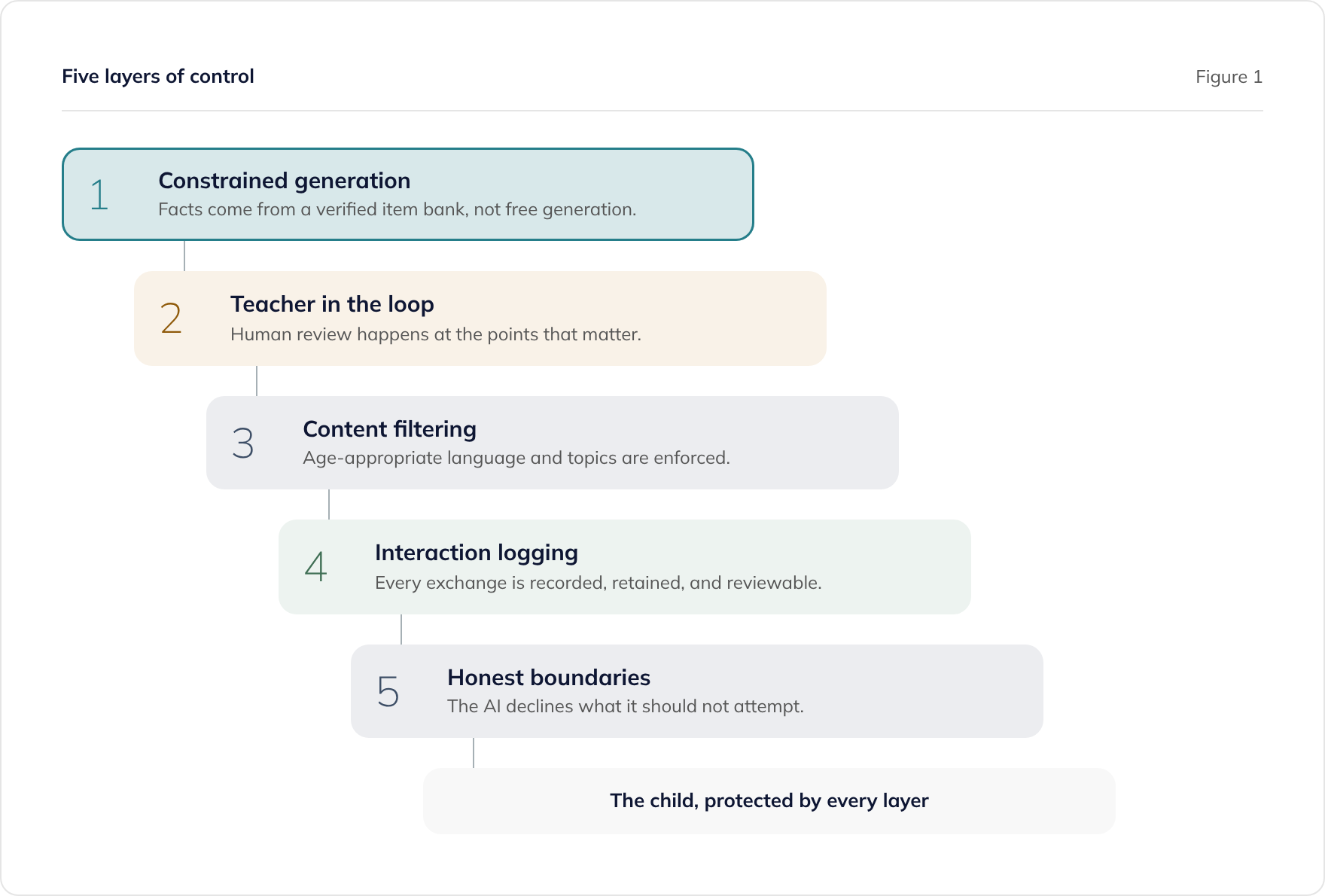
AI tutoring for children is viable only with layered controls, not because the technology is magic and not because it is uniquely dangerous. Five layers make it safe: constrained generation against a verified item bank, teacher-in-the-loop review, age-appropriate content filtering, full interaction logging, and honest boundaries on what the AI can do. On the data side, the ICO Children’s Code shapes what you can build, and whether the Online Safety Act applies turns on whether children can share what the AI produced. This guide names the risks plainly, sets out the control architecture layer by layer, and gives an honest assessment of how mature the field really is. Building this responsibly is our AI development and implementation work.
Is AI tutoring safe for children?
AI tutoring can be safe for children, but only when the AI sits inside a designed system of controls rather than being handed to a child unsupervised. The safety is in the architecture around the model, not in the model itself. A general-purpose chatbot given to a nine-year-old with no constraints is not a tutoring product. It is an unmanaged risk.
This guide takes a deliberately measured tone. AI in children’s learning is neither the revolution some vendors claim nor the menace some headlines imply. It is a powerful tool with specific, well-understood failure modes, and those failure modes can be engineered against. The right question is not whether AI is safe in the abstract. It is whether a particular product has the controls that make it safe in practice.
What are the actual risks?
Four risks account for most of the concern, and each is specific enough to design against. Naming them plainly is the first step, because vague anxiety produces either paralysis or false comfort.
Hallucinated facts
Language models produce fluent, confident text that is sometimes wrong. A model that invents a plausible but incorrect fact, and presents it to a child as authoritative, is a serious problem rather than a rough edge. Children are less able than adults to spot that an answer is wrong, and a confident wrong answer from a trusted tutor can embed a misconception.
Inappropriate content
An unconstrained model can generate language, examples, or responses that are not appropriate for a child, whether through a prompt that steers it there or through the ordinary unpredictability of open generation. In a children’s product the tolerance for this is effectively zero, which is why open generation to a child, without filtering, is not acceptable.
Over-reliance
A tutor that always gives the answer teaches a child to ask rather than to think. Over-reliance is a pedagogical risk and a wellbeing one, and it is easy to build accidentally. A well-designed product makes the AI support the learning rather than short-circuit it, and keeps a human accountable for the child’s progress.
Data protection
Children’s personal data carries heightened obligations under UK GDPR and the ICO Children’s Code. What you collect, how you use it, whether you profile, and how long you keep it are all constrained. Interaction logs from an AI tutor are themselves sensitive, because they can reveal a great deal about a child, and they must be handled accordingly.
What does the control architecture look like, layer by layer?
Safety comes from layers, not a single safeguard. If one layer fails, the next should still protect the child. This is defence in depth applied to a children’s learning product, and each layer addresses a specific risk named above.
Layer one: constrained generation
The single most important control is that facts a child sees come from verified content, not open generation. Constrain the model to a reviewed item bank and known solutions, and use it to phrase, explain, and encourage rather than to invent. This directly defuses the hallucination risk, because the model is no longer the source of truth. We describe how the verified item bank is built in structuring a learning content library for adaptivity and AI.
Layer two: teacher in the loop
Define the points where a human must review, and make them non-optional. Generated content enters the bank only after human sign-off. Flagged interactions are surfaced to a teacher or tutor. Progress judgements that matter stay with the human who is accountable for the child. Teacher-in-the-loop is not a fallback for when the AI fails. It is a designed part of how the product works.
Layer three: content filtering
Filter both what goes into the model and what comes out, tuned to the age of the child. This includes blocking inappropriate topics, enforcing age-appropriate language, and refusing prompts that try to steer the model somewhere it should not go. Filtering is imperfect, which is exactly why it is one layer among five rather than the whole safeguard.
Layer four: interaction logging
Log every interaction, in full, with proper retention and access controls. Logging serves safeguarding, because it lets a responsible adult review what a child was shown and said. It serves quality, because it reveals where the product misbehaves. It serves accountability, because it is the audit trail. Treat the logs themselves as sensitive children’s data and protect them accordingly.
Layer five: honest boundaries
Decide what the AI is not allowed to do, and make it decline clearly. It should not offer medical, legal, or safeguarding advice. It should not pretend to be a human. It should hand off to a person when a child raises something that needs one. Honest boundaries protect the child and set accurate expectations for parents and staff.
What does the Children’s Code mean for an AI learning product?
If your service is likely to be accessed by children in the UK and processes their personal data, the ICO Children’s Code applies. It is not a separate law. It explains how UK GDPR applies to children using digital services, and conformance is assessed against 15 standards.
Translated into product decisions, several standards shape an AI tutoring build directly:
- Best interests of the child first. The child’s best interests are the primary consideration in design, ahead of engagement or commercial goals. This is a design principle, not a slogan, and it should be visible in the choices you make.
- High-privacy defaults and data minimisation. Collect the minimum personal data needed, and default settings should be high privacy. For an AI tutor, that constrains what you log about a child and how long you keep it.
- Profiling off by default. Profiling that could affect a child should be off unless there is a compelling, documented reason to switch it on. Adaptive sequencing over mastery is defensible when it serves the child’s learning; behavioural profiling for other purposes is a different matter.
- Transparency the child can understand. Explain what the service does with data in terms a child of the relevant age can grasp, not only in a policy written for adults.
Because the ICO updates its guidance, confirm the current detail against the ICO’s guidance and resources rather than relying on any summary, including this one. In a school context, safeguarding duties under the Department for Education’s statutory guidance, Keeping Children Safe in Education, including its filtering and monitoring expectations, also apply. The practical takeaway is that data protection and safeguarding are design inputs from the first sprint, and a data protection impact assessment is the right place to start.
Does the Online Safety Act apply to an AI tutor?
Often it does not, and the reason is structural rather than anything to do with AI. Ofcom has set out how the Act applies to generative AI in an open letter to service providers and a fuller explainer on AI chatbots. Scope turns on what the product lets users do with what the model produces.
A chatbot sits outside the Act where users interact only with the bot and not with each other, the service does not search multiple websites or databases to answer, and it cannot generate pornographic content. A one-to-one AI tutor answering from a verified item bank usually meets that description.
Three product decisions pull a tutor back into scope:
- Sharing. If children can share what the AI produced with other users, through a class feed, a shared workspace, or a peer-review flow, the service becomes a user-to-user service. Content a user shares is treated as user-generated content whether a model or a person wrote it.
- Search. Functionality that searches more than one website or database in responding can make the service a search service.
- Generated imagery. A tool capable of generating pornographic material can attract Part 5 duties, including highly effective age assurance. That is unlikely by design in a tutoring product, and it is a good reason to constrain image generation rather than leave it open.
The boundary is also moving. In February 2026 the government said it would amend the Crime and Policing Bill to bring AI chatbot providers currently outside the Act within the illegal content duties, so this is worth re-checking rather than settling once at the start of a build.
In practice, the feature that changes your regulatory position is usually a sharing feature, and sharing features tend to be added later by a team that does not know they carry that weight. Put the scope question into the design review for anything that lets one child see what another child’s AI session produced.
What should you tell parents?
Tell parents the truth, in plain language, before they ask. Parents increasingly want to know whether AI is involved in their child’s learning, what it does, and what protects their child. A product that is straight about this earns trust. One that hides it loses trust the moment it is discovered.
A good parent-facing explanation covers four things:
- What the AI does and does not do. Be specific. It helps explain and practise. It does not replace the tutor, and it does not make decisions about the child alone.
- How facts are kept accurate. Explain that the AI works from reviewed content, and that a human checks the material.
- What data is collected and why. In clear terms, what you store, how long, and who can see it.
- How a human stays involved. Name the teacher-in-the-loop points so parents know a person is accountable.
How mature is AI tutoring really?
An honest assessment: the field is early, and the gap between marketing and reality is wide. The underlying models are genuinely capable of drafting content and explaining concepts well. The systems that safely wrap them for children are far less mature, and most products on the market are stronger on demonstration than on the unglamorous controls that make them safe at scale.
What is well established today is that AI accelerates content creation and can phrase feedback helpfully, both under human review. What is not established is that an AI tutor improves learning outcomes on its own, unsupervised, at scale. Claims of the second kind deserve scepticism and evidence, measured in learning outcomes rather than engagement, as we discuss in how adaptive learning platforms actually work.
We hold ourselves to the same standard we ask of others, and we publish our own AI adoption data quarter by quarter in the AI Velocity Report. The measured position is the credible one: use AI where it demonstrably helps, wrap it in controls where children are involved, and be honest about the boundary. That honesty is not a weakness in a children’s product. It is the whole point.
Where to start
If you are weighing AI features in a children’s learning product, start with the risks named here and the five control layers. Make a data protection impact assessment your first artefact, not your last. The controls are buildable, but they have to be designed in, not bolted on.
We build AI into children’s learning products responsibly, with the controls above as the default rather than the upgrade. See our AI development and implementation service and our tutoring and supplementary education work. If you are weighing whether to build or replace the platform these features live in, our guide on replacing your tuition centre management system sets out the framework. Or book a consultation to talk through your product with people who will tell you what AI should and should not be trusted to do.
Frequently asked questions
Is AI tutoring safe for children?
How do you stop an AI tutor from hallucinating?
What controls should an AI learning product have?
Does the Online Safety Act apply to an AI tutoring product?
Does the Children's Code apply to an AI tutoring product?
Should an AI tutor replace a human teacher?
Related guides
Is Claude GDPR Compliant? Anthropic Assurance for UK Businesses
How UK businesses get GDPR and ISO 27001 assurance over Anthropic's Claude: commercial terms, the DPA, certifications, EU data residency options, retention settings, and a supplier due diligence checklist.
Claude Code vs GitHub Copilot for .NET Teams: A UK CTO's Guide
Claude Code vs GitHub Copilot for .NET teams: autocomplete versus agentic delivery, what Copilot running Claude models changes, and how UK CTOs decide.
Claude on Azure: Choosing Between Claude and Azure OpenAI in Microsoft Foundry
Claude vs Azure OpenAI in Microsoft Foundry: what Claude's GA on Azure changes for procurement, governance, and residency, and how UK teams should choose.