
API & Integration Services
Connect your systems.
Build APIs that last.
From public REST APIs managed through Azure API Management (APIM) to event-driven messaging architectures, we cover the full integration spectrum. We design, build, and operate integration layers that are secure, observable, and built for change. REST, gRPC, GraphQL, Service Bus, and Event Hubs: protocol agnostic, outcome focused.
Integration challenges that hold your teams back
Systems that should share data but require manual re-entry or fragile file exports between them.
APIs without rate limiting, authentication, or audit trails, leaving security gaps between connected systems.
Point-to-point integrations that break every time one system is updated or replaced.
Messages lost or processed twice, with no way to trace where a failure occurred.
A legacy system that cannot be replaced but needs to connect to modern platforms and services.
No visibility into what data is flowing between systems, or why something failed overnight.
Full-spectrum API and integration expertise
Our API integration services cover every major integration pattern used in modern Azure architectures, picking the right tool for your use case rather than the same solution every time.
REST API design & build
Azure API Management (APIM)
gRPC & high-performance services
GraphQL APIs
Azure Service Bus & async messaging
Messaging patterns & event-driven design
Go deeper on each technology
Each integration pattern has its own characteristics, trade-offs, and implementation considerations. Explore our specialist pages below.
Azure API Management (APIM)
Policy-driven API gateway, developer portals, rate limiting, and analytics.
Learn moreREST API Development
Standards-based REST APIs from internal microservices to public developer platforms.
Learn moregRPC & Protobuf Services
High-performance, type-safe inter-service communication for microservice architectures.
Learn moreGraphQL API Development
Flexible, self-describing APIs that let clients query exactly what they need.
Learn moreAzure Service Bus Integration
Reliable async messaging with queues, topics, and dead-letter handling on Azure.
Learn moreMessaging Patterns & Event-Driven Design
Pub/sub, queuing, and event streaming architectures using Azure Service Bus, Event Grid, and Event Hubs.
Learn moreLearnosity Integration
Learnosity Build integration on Azure: assessment authoring, adaptive delivery, analytics, and content migration for education.
Learn moreAn integration partner you can trust with your critical data flows
Microsoft Solutions Partner
As a designated Microsoft Solutions Partner, we have verified deep expertise in Azure, from APIM policy authoring to Service Bus topology design and Event Hubs integration.
Protocol agnostic, outcome focused
We don't default to one pattern. We assess your payload characteristics, latency requirements, consumer diversity, and team capability before recommending REST, gRPC, GraphQL, or messaging.
Proven in regulated, public-facing APIs
We have delivered publicly accessible REST APIs managed through Azure APIM and enhanced mission-critical government APIs, including the UK Livestock Unique Identification System.
Security built into every API
OAuth 2.0, API key policies, TLS everywhere, JWT validation, and rate limiting are part of every engagement, not bolt-ons. We treat your API surface as a security boundary from day one.
End-to-end ownership
We design, build, test, document, and operate your integration layer. Through our Managed Application Support service we can keep it running at peak performance post-launch.
"Talk Think Do have been a valuable support to CalMac, taking the time to understand our needs and provide a seamless support service whilst being responsive and reactive to additional requests and challenges."
Procurement Manager
CalMac Ferries
Supporting a mission-critical integration platform

Mission-critical network supported
Responsive application support for the UK's largest ferry network, ensuring reliable operations across 160,000 sailings and 5 million passengers annually.
Enhanced integration capabilities
Improved data flows, stability, and operational efficiency through API and integration enhancements, supporting seamless communication between core systems.
Proactive technical assurance
Independent technical due diligence on core systems provides CalMac with assurance and recommendations for system improvements and strategic investments.
Enhancing a mission-critical government API

25 million tags managed
Supported the ordering and fulfilment of over 25 million livestock identification tags in the 2024-2025 period, maintaining compliance for the UK livestock sector.
Improved code quality and maintainability
Targeted refactoring and extensive automated testing reduced long-term maintenance costs and enabled faster feature delivery.
Policy-ready platform evolution
Enhanced LUIS to support additional livestock categories and new ordering processes, ensuring the mission-critical system can respond quickly to evolving policy requirements.
Integration that delivers measurable results
Well-designed integrations do not just connect systems. They reduce cost, eliminate risk, and unlock capabilities your teams need.
Fewer outages
Reliable, monitored integrations with dead-letter handling, retry logic, and alerting replace fragile point-to-point connections.
Faster partner onboarding
Documented APIs with developer portals and OpenAPI specs let partners self-serve credentials and start building immediately.
Audit-ready data flows
APIM policies, structured logging, and message tracing create the audit trail that regulated industries require.
Less manual re-entry
Automated data flows between systems eliminate the spreadsheets, copy-paste, and email-based workarounds your team relies on.
How an API and integration project flows
From discovery through contract-first development to live operations.
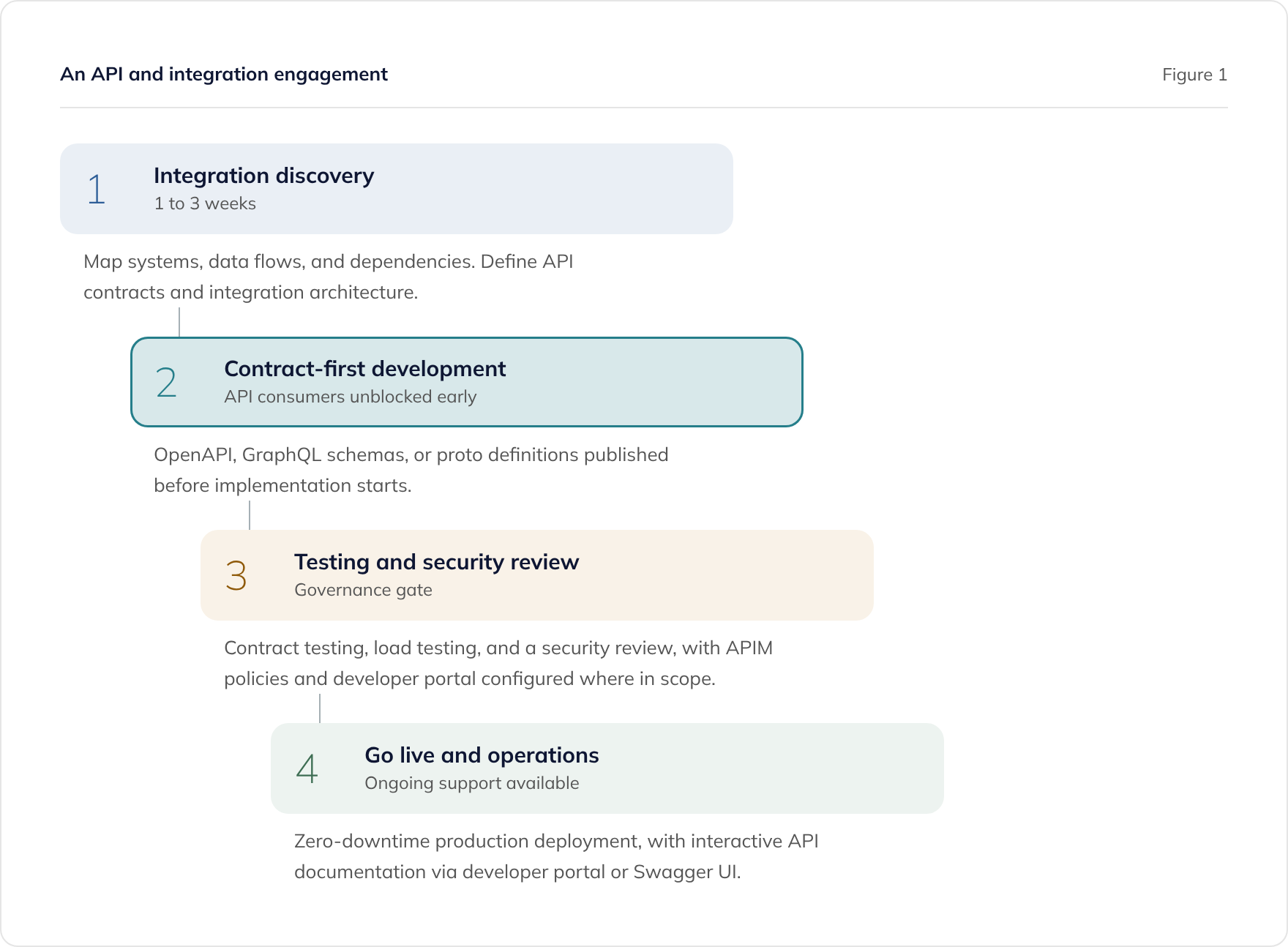
Our integration delivery process
From discovery to live operations, every step is designed to reduce integration risk and keep your teams unblocked.
Integration Discovery & Architecture
We map your current systems, data flows, and consumers. We identify what needs to connect, agree on protocols, and design the integration architecture: API contracts, message schemas, security boundaries, and APIM topology.
You get a documented integration blueprint before a line of code is written.
Build & Contract-First Development
We build to the agreed contract: OpenAPI specs for REST, proto files for gRPC, SDL schemas for GraphQL. Development runs in sprint cycles with demos and API mocks available for your consuming teams early, reducing downstream dependencies.
Testing, Security Review & APIM Configuration
Every API goes through automated contract testing, load testing, and a security review. Where Azure APIM is in scope we configure policies, products, developer portal, and monitoring dashboards before go-live.
Go Live & Ongoing Operations
We deploy to production with zero-downtime strategies. We provide API documentation, interactive via developer portal or Swagger UI.
Ongoing support through our Managed Application Support service includes SLA-backed incident response, version management, and deprecation planning.
Your integration team
Our permanent, UK-based engineers and architects work alongside your development and operations teams.
Solution Architect
Designs the integration architecture: protocol selection, API contracts, message schemas, APIM topology, and security boundaries.
Senior Software Engineers
Build the APIs, services, and messaging infrastructure using C#/.NET, with AI-augmented tooling to accelerate delivery.
Delivery Manager
Your main point of contact. Manages scope, timeline, and stakeholder communication to keep delivery on track.
QA Analyst
Contract testing, load testing, and security validation for every API and integration before it reaches production.
About Talk Think Do
Talk Think Do is a UK-based integration consultancy founded by Matt Hammond and headquartered in Bournemouth, Dorset. We are a Microsoft Solutions Partner with designations in Azure Infrastructure, Digital & App Innovation, and DevOps & GitHub.
We have delivered public-facing REST APIs, government integration platforms, and event-driven architectures for clients including CalMac Ferries, Livestock Information Services, and education publishers. Our integration work spans REST, GraphQL, gRPC, Azure APIM, Service Bus, and Event Hubs.
AI-augmented delivery accelerates every phase of integration work. AI tools generate API specifications, mapping code, and contract tests, compressing timelines while maintaining the quality and governance that enterprise integrations demand.
Related reading
Planning an Integration Strategy: A Guide for Business and Technology Leaders
REST vs GraphQL vs gRPC: Choosing the Right API Style
API Versioning Strategies That Actually Work at Scale
Backend for Frontend (BFF): API Patterns for Mobile and Web
From Integration to Innovation: Exploring Custom AI Solutions
Agentic Design: Your AI Agent Advantage
Seen enough? Let's talk through your requirements.
Book a free consultationFrequently asked questions
What do your API integration services cover?
Our API integration services cover the full lifecycle: design, build, security, testing, and ongoing operations. We connect applications, SaaS platforms, and legacy systems using the right pattern for each case.
That includes:
- REST, GraphQL, and gRPC API development
- Azure API Management (APIM) gateways and developer portals
- Event-driven messaging with Azure Service Bus and Event Hubs
- Third-party and legacy system integration
Which API protocol should I use: REST, gRPC, or GraphQL?
It depends on who your consumers are and what the data characteristics look like. REST is the safest default for public APIs and third-party integrations. gRPC is better for internal, high-performance service-to-service calls. GraphQL shines when clients (especially web/mobile) need flexible queries over complex, related data. In practice, many systems use all three for different parts of the stack. We help you decide.
Do I need Azure API Management if I already have APIs?
Not always, but if you have more than a handful of APIs, public consumers, or need to enforce rate limits, authentication policies, or analytics centrally, APIM pays for itself quickly. It also provides a developer portal so external teams can self-serve credentials and documentation.
What is the difference between Azure Service Bus and Azure Event Hubs?
Service Bus is a managed enterprise messaging broker, ideal for reliable, ordered message delivery between applications with features like sessions and dead-lettering. Event Hubs is an event streaming platform designed for very high throughput, durable event logs, and replay capabilities (with a Kafka-compatible endpoint).
Many architectures use both: Service Bus for application integration, Event Hubs for telemetry and analytics pipelines. We help you choose based on your volume, durability, and consumer requirements.
Can you integrate with our existing third-party systems (Salesforce, SAP, etc.)?
Yes. We build integration layers using Azure Logic Apps, Azure Functions, or custom microservices to connect your Azure-hosted applications with SaaS platforms and legacy systems. We always favour durable, well-tested integration over fragile connector chains.
What does a public REST API project look like with Talk Think Do?
We've delivered public-facing REST APIs managed through Azure APIM, covering contract design, security policy authoring, developer portal setup, load testing, and ongoing management. We treat a public API as a product, not just an endpoint.
How do mobile backends fit into this?
Mobile backends are a closely related area we cover separately. Your integration layer often forms the foundation your mobile backend builds on, so we design them to work well together. Get in touch to discuss mobile backend requirements alongside your integration needs.
How much does an integration project cost?
A single API or integration typically costs £15,000 to £60,000 depending on complexity, security requirements, and the number of consuming systems. An integration programme spanning multiple systems and an API gateway ranges from £50,000 to £200,000+. The discovery phase (1-3 weeks) produces a detailed estimate before you commit. See our pricing guide for more detail.
How long does an integration project take?
A focused integration (single API or system connection) takes 2-6 weeks with AI-augmented delivery. An API gateway implementation takes 4-8 weeks. A multi-system integration programme takes 3-12 months, delivered in phases so you see value incrementally.
See how AI is changing how we build software
Our quarterly AI Velocity Report tracks real delivery metrics from live projects: how much of our code is AI-authored, how delivery timelines compare to baseline, and which tools are making a measurable difference. No marketing spin, just honest data from a team that builds software every day.
Read the latest AI Velocity ReportReady to build an integration layer that won't let you down?
Whether you need a public REST API on Azure APIM, a gRPC service mesh, a GraphQL gateway, or an event-driven messaging architecture, we'd love to hear about your integration challenges.
Book a free consultation with one of our solution architects to discuss your requirements, technology choices, and what a successful project looks like.
Book a free consultationor call 01202 006729