
How to Choose Franchise Software: A Buyer's Guide and RFP Checklist
Choosing franchise software is hard because most products are strong at either head-office oversight or day-to-day operations, rarely both. This guide gives you the criteria that matter, an RFP checklist you can lift straight into a tender, and a structured evaluation process that stops a polished demo from making the decision for you. If your evaluation points to a custom-fit platform, our custom software development service and the Franchising accelerator cover the next steps.
Why is franchise software so hard to choose?
The franchise software market is split. Some products are built for the franchisor and excel at royalties, compliance, and reporting. But they treat the unit’s day-to-day transactional workflows (booking, billing, member management) as an afterthought, even where they ship a head-office ‘operations’ module for field audits and brand standards. Others are excellent operational tools with no concept of franchising at all. We cover this split in depth in franchise management versus operations software.
The practical consequence for a buyer is that a demo can look impressive while hiding exactly the weakness that will hurt you. A franchise management system will show you a beautiful network dashboard and gloss over how clunky day-to-day booking is. An operational tool will show you a slick booking flow and stay quiet about the fact that it cannot calculate a management service fee.
A structured evaluation protects you from this. Decide your criteria first, score every option against the same list, and insist on seeing your own hardest workflows.
What criteria actually matter?
Score every candidate against these eight criteria. Weight them for your own network, but do not drop any of them.
1. Operational depth
The tools franchisees use daily: scheduling and availability, real-time capacity and waitlists, recurring billing and payments, and customer or member management. This is where franchisees live. If it is weak, they will work around it, and your network data will suffer.
2. Franchise layer
A genuine model of your network: franchisor, franchisee, and territory hierarchy, support for directly operated locations alongside franchised ones, configurable management service fee (MSF) and royalty structures, and network-level aggregation. Without this, you are buying an operational tool that cannot see your network. For a worked example of the model, see franchise hierarchy.
3. Data as a single source of truth
Does the platform calculate fees and reporting from operational data, or from figures entered or synced separately? Fees built on actual payment records remove reconciliation and disputes. Two systems syncing copies of revenue figures will drift.
4. Permissions and data isolation
Can a franchisee ever see another franchisee’s data? The right answer is no, enforced architecturally rather than by a configuration setting that someone can get wrong. Check that permissions are scoped by hierarchy and resolved automatically when locations change, and that sensitive fields are masked in the API rather than hidden in the UI; scoped permissions shows what good looks like.
5. Compliance tracking
Document storage for certificates, insurance, and qualifications, configurable expiry alerts, and a network-wide compliance view for head office. If this is missing, compliance reverts to emailed PDFs and a spreadsheet of renewal dates.
6. Reporting and benchmarking
Network dashboards that drill from network to franchisee to location, with month-on-month comparison and anonymous or named benchmarking. The reporting is only as trustworthy as the data underneath it, which is why criteria 3 matters so much.
7. Security, data protection, and integration
Data residency, access controls, audit logging, and GDPR posture. Open APIs so the platform connects to the rest of your stack. Ask where data is hosted, how it is secured, and what certifications the vendor holds; our data protection and audit pages show the level of detail worth demanding.
8. Commercial model and data ownership
How does pricing scale as you grow? Per-user, per-member, or per-site fees climb with your network. Compare total cost of ownership over three to five years, and weigh subscription against an owned platform with a perpetual licence. Check data ownership and exit terms: can you leave with your data and, ideally, your code? For the full economics, see own vs rent: perpetual licence versus per-member SaaS.
The franchise software RFP checklist
Lift these questions straight into a tender. Ask vendors to demonstrate, not just describe, the items marked with an asterisk.
Franchise model
- Does the platform model a franchisor, franchisee, and territory hierarchy?
- Are directly operated locations supported alongside franchised ones?*
- Are MSF and royalty structures configurable per agreement (percentage, flat, tiered, custom)?*
- Can a single franchisee own and manage child franchisees (master franchise)?
Operations
- Demonstrate a mid-period membership change with correct pro-rata billing.*
- Demonstrate recurring Direct Debit collection, including a failed payment and its handling.*
- Demonstrate booking with capacity limits, a waitlist, and a cancellation policy.*
- How are credits, refunds, and write-offs handled?
Data, fees, and reporting
- Are MSF and royalties calculated from actual payment records, or from separately entered figures?*
- Show a management service fee statement and drill into the underlying transactions.*
- Demonstrate a network dashboard drilling from network to franchisee to location.*
Permissions and compliance
- Can a franchisee ever see another franchisee’s data? Demonstrate the boundary.*
- Are permissions scoped by hierarchy and resolved automatically when a user covers multiple locations?
- Demonstrate compliance document storage with an expiry alert and a network compliance view.*
Security, integration, and commercials
- Where is data hosted, how is it secured, and what certifications do you hold (for example ISO 27001, Cyber Essentials)?
- What APIs and integrations are available?
- How does pricing scale with users, members, and locations? Provide a three- and five-year total cost of ownership.*
- What are the data ownership and exit terms? Can we leave with our data?
How should you run the evaluation?
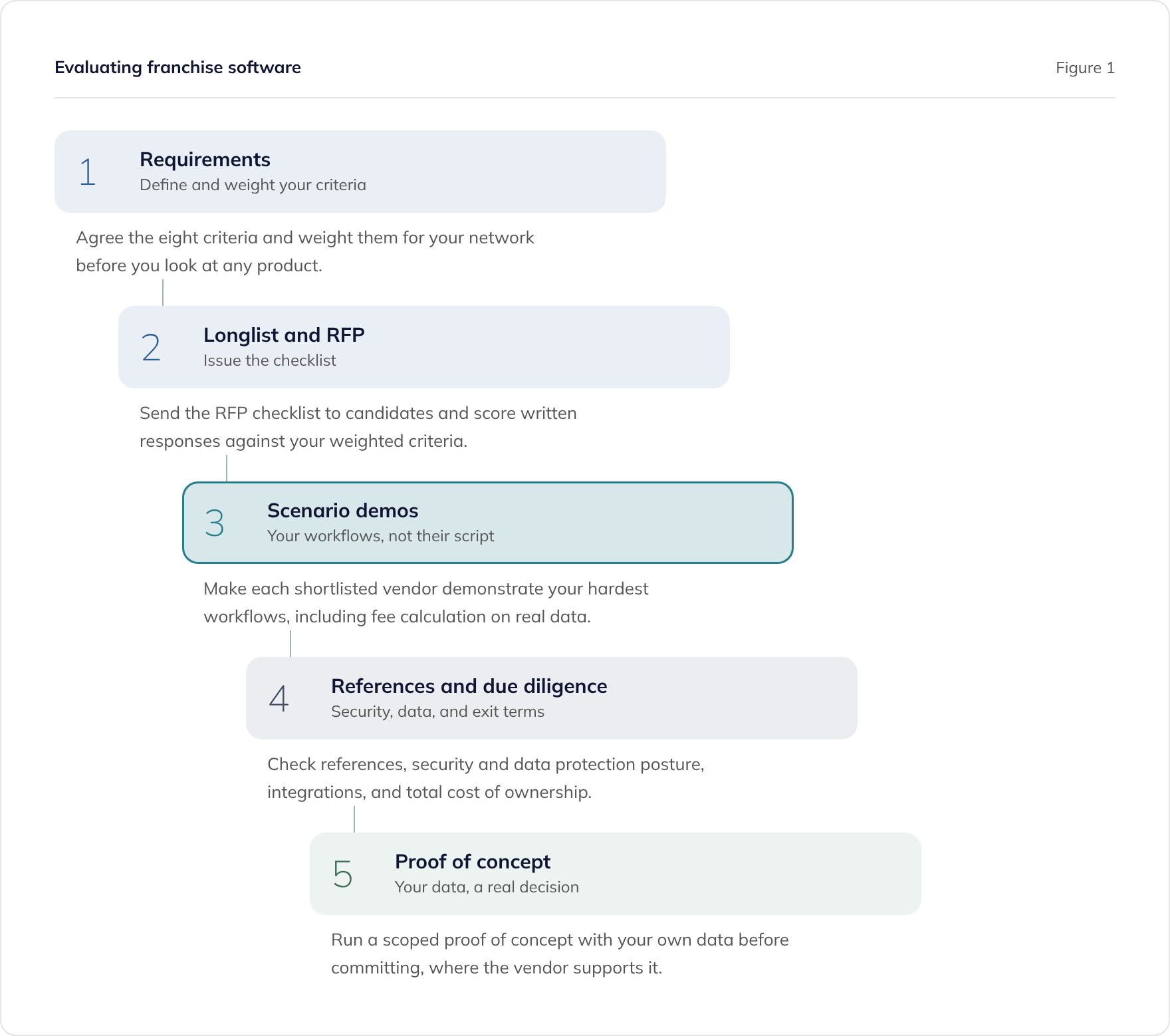
A good process is sequential and evidence-led. Each phase narrows the field before you invest more time.
Phase 1: Requirements
Agree your eight criteria and weight them before looking at any product. This stops a strong demo in one area from dominating the decision.
Phase 2: Longlist and RFP
Issue the RFP checklist and score written responses. Vendors that cannot answer the data and fee questions clearly are usually weak there.
Phase 3: Scenario demos
Insist on seeing your own hardest workflows: a mid-period change with pro-rata billing, a franchisee covering two locations, an MSF statement drawn from actual payments, and a compliance document approaching expiry. This is where the operations gap becomes visible.
Phase 4: References and due diligence
Talk to existing customers of a similar size and model. Check security, data protection, integrations, and the three- and five-year total cost of ownership.
Phase 5: Proof of concept
Where the vendor supports it, run a scoped proof of concept with your own data. There is no better way to test workflow fit than to use the system for real.
What if no product fits?
Sometimes the evaluation reveals that no off-the-shelf product is strong at both your operations and your franchise model, and that the two-system route would saddle you with permanent reconciliation. That is a common outcome for operators with unusual workflows or ambitious growth plans.
When that happens, a custom-fit platform built on proven accelerator modules is worth assessing. AI-augmented delivery and a library of booking, billing, membership, and franchising components mean an owned platform no longer means building from scratch. See build vs buy in the AI-augmented era for the general framework, the Franchising accelerator for what an operations-first franchise platform looks like, and our bespoke franchise platforms service for how we deliver one.
Book a franchise software evaluation
We offer a free 30-minute evaluation session for franchise operators. Bring your requirements, your current tools, and your hardest workflow, and we will help you apply the criteria and the RFP checklist to your own situation.
No pitch, no obligation. If an off-the-shelf product is the right answer, we will tell you.
Frequently asked questions
What should franchise operators look for in software?
What should be in a franchise software RFP?
How do I evaluate franchise software without being misled by a demo?
Should franchise software be one system or two?
How important is the commercial model when choosing franchise software?
Related guides
SaaS to Custom Software Migration: A 90-Day Playbook
How to migrate from SaaS to custom software: getting your data out, running both in parallel, cutting over safely, and exiting the contract.
Build In-House with AI or Use a Development Partner? An Honest Decision Guide
AI coding tools make in-house builds genuinely viable. A balanced decision guide for CTOs: when to build with your own team, when a partner earns its fee, and how to compare total cost honestly.
How franchise payments and payouts should work
How a franchise network collects payments and pays its franchisees: connected accounts with Stripe Connect, Direct Debit, and who holds the funds and the risk.