
Franchise Management vs Franchise Operations Software: Why Networks End Up Running Two Systems
Franchise networks face a split market. Software built for the franchisor’s oversight (royalties, compliance, benchmarking) tends to be weak at the day-to-day operations franchisees live in (booking, billing, members). Best-of-breed operational tools have no concept of franchising. So networks buy one of each and reconcile between them by hand. This guide explains the operations gap, what it costs, and how a platform that is first-class at both closes it. When the answer points to a custom-fit build, our custom software development service and the Franchising accelerator cover the next steps.
Why does a franchise network end up with two systems?
Ask a franchisor what their software does well and you usually hear one of two answers. Either “head office has great visibility, but franchisees complain the day-to-day tools are clunky”, or “the operational software our franchisees use is excellent, but it knows nothing about franchising, so we run our royalties and compliance separately”.
Both answers describe the same structural problem. The software market for franchising is split down the middle:
- Franchise management systems are built for the franchisor’s point of view. They are strong at royalty and management service fee (MSF) collection, compliance tracking, field audits, onboarding, network benchmarking, and reporting up to head office. Many of these products do have an “operations” module, but it means head-office field operations and brand standards, not the customer-facing systems a location actually runs on. The day-to-day transactional workflows, bookings and scheduling, recurring billing, payments, and customer or member management, tend to be basic or bolted on, so the experience for staff and customers suffers.
- Operational systems (booking platforms, billing engines, membership tools) are built for a single operator. They are excellent at scheduling, payments, and member management, but they have no concept of a franchisor, a franchisee, a territory, or an MSF. They cannot aggregate a network or calculate a fee. Networks that adopt them end up stitching several specialist tools together, and every gap between those tools is a place where data is lost and manual reconciliation creeps in.
A network that wants both strong oversight and strong operations cannot find it in one product, so it buys one of each. The result is two systems, two sources of truth, and a manual reconciliation layer in between.
What does the operations gap actually cost?
The gap between what a franchise management system assumes and what franchisees actually do is where the cost hides. It rarely shows up as a line item. It shows up as friction.
Franchisees work around the software
When the system does not fit how the business works, franchisees build their own layer on top. Fee calculations move into spreadsheets. Compliance documents are emailed as PDF attachments and tracked in someone’s inbox. Reconciliation between the operational tool and the franchise system is done by hand at month end.
This is invisible in a software comparison but expensive in practice. Every hour a franchisee spends reconciling is an hour not spent running their location, and every manual step is a chance for an error that surfaces later as a dispute.
Head office sees data it cannot fully trust
When franchisees self-report revenue or enter figures into a separate management system, the franchisor’s network view is only as good as what was entered. Numbers arrive late, in different formats, with gaps. Benchmarking across the network becomes an argument about data quality rather than a discussion about performance.
Reconciliation becomes a permanent tax
Two systems never agree perfectly. Someone has to investigate the differences, every period, forever. That reconciliation effort is a permanent operating cost that grows with the size of the network, and it produces nothing except the confidence that the two systems are roughly aligned.
For a structured way to weigh these hidden costs against licence and build costs, the same scoring discipline in our guide on when to replace SaaS with custom software applies directly to franchise tooling.
How do the three approaches compare?
There are really three ways to equip a franchise network. The first two are the common compromises. The third is the one most operators do not realise is available.
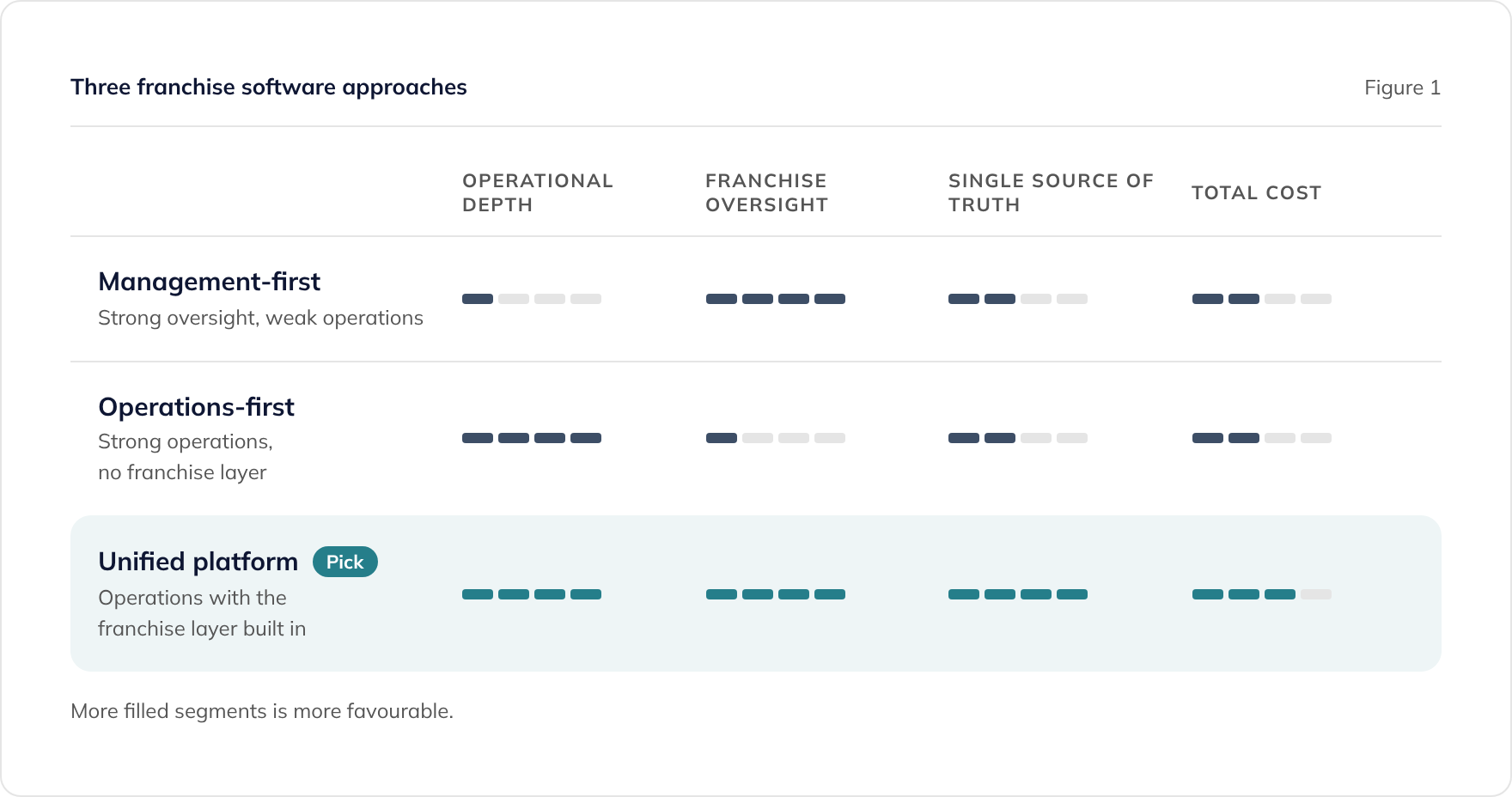
Management-first: strong oversight, weak operations
You get the royalty, compliance, and reporting tools head office needs, but franchisees inherit basic booking and bolt-on billing. The operations gap appears immediately, and the spreadsheet layer grows.
Operations-first: strong operations, no franchise layer
Franchisees get tools they like, but head office has to run royalties, MSF, and compliance in a separate system. Reconciliation becomes the permanent tax, and network reporting depends on self-reported data.
Unified platform: operations with the franchise layer built in
A platform that starts from best-of-breed booking, billing, and membership, then adds the franchisor, franchisee, and territory hierarchy on top. Fees are calculated from the operational payment records themselves. There is one source of truth, no reconciliation layer, and franchisees get software they actually want to use. This is the approach the Franchising accelerator takes.
Why does calculating fees on operational data matter so much?
The single most important difference between a unified platform and two integrated systems is where the money figures come from.
A management service fee is almost always calculated as a percentage of a location’s gross turnover. That percentage is typically in the region of 5 to 10 percent, though it varies by network and sector. That means the fee is only ever as accurate as the revenue figure it is based on, which is exactly the figure the two systems disagree about.
In a two-system world, the franchise management system holds revenue figures that were either entered by hand or synced from the operational tool. Either way, they are a copy, and copies drift. When the franchisor and the franchisee disagree about a royalty, they are really disagreeing about whose copy is correct.
In a unified platform, the management service fee is calculated directly from the billing engine’s actual payment records. The franchisor sees the same numbers the franchisee’s customers paid against. There is nothing to reconcile and nothing to dispute, because there is only one set of figures. Statements are generated per franchisee per period, and both sides can drill into the underlying transactions.
That single change, fees built on operational truth rather than self-reported figures, removes an entire class of friction from the franchisor-franchisee relationship.
Should you buy two systems, or build a unified one?
This is a build-versus-buy decision, and it should be made on evidence rather than instinct. The question is how far your operational and franchise requirements diverge from what off-the-shelf products offer.
- If your booking, billing, and member-management needs are fairly standard, and your network is small, licensing one operational tool and one management tool and accepting some reconciliation may be the pragmatic choice.
- If your operations are unusual, your network is growing, or reconciliation between two systems is costing real time and eroding trust, a unified platform that is first-class at both is often more cost-effective over time. It also removes the operations gap entirely.
The economics of a custom-fit build have changed. AI-augmented delivery and a library of proven accelerator modules mean a unified platform no longer means starting from a blank page. For the general decision framework, see our guide on build vs buy in the AI-augmented era. For the commercial model behind an owned platform, see own vs rent: perpetual licence versus per-member SaaS, or model the five-year numbers with the franchise software cost calculator. And if you decide to build, see how we deliver bespoke franchise platforms.
What should a unified platform include?
If you decide a unified platform is the right answer, these are the capabilities that close the operations gap. Use them as a checklist when evaluating any option, and see our franchise software buyer’s guide for the full evaluation process. For the franchisee-facing side of adoption, see what a franchisee field app should actually do.
- A clean ownership chain from network to franchisee to territory to location, with support for directly operated locations alongside franchised ones. See how the franchise hierarchy models this.
- Best-of-breed operations: booking, scheduling, recurring billing, payments, and member management that franchisees genuinely want to use.
- Fees on operational truth: MSF and royalties calculated from actual payment records, with auditable statements both sides trust.
- Multi-level permissions enforced architecturally, so a franchisee can never see another franchisee’s data, regardless of configuration. See scoped permissions for how this is done at the API.
- Compliance tracking with document storage and expiry alerts, and a network-wide compliance view for head office.
- Network dashboards and benchmarking drawn from the same operational data, so reporting is trustworthy by construction.
Book a franchise operations review
We offer a free 30-minute review for franchise operators. Bring your current setup, whether that is one system, two, or a spreadsheet layer holding it together, and we will map where the operations gap is costing you and what closing it would involve.
No pitch, no obligation. If your current tools are the right answer, we will tell you.
Frequently asked questions
What is the difference between franchise management software and franchise operations software?
Why do franchise networks end up with two systems?
What is the operations gap in franchising?
Is it better to buy franchise software or build a custom platform?
How does building franchise fees on operational data change things?
Related guides
SaaS to Custom Software Migration: A 90-Day Playbook
How to migrate from SaaS to custom software: getting your data out, running both in parallel, cutting over safely, and exiting the contract.
Build In-House with AI or Use a Development Partner? An Honest Decision Guide
AI coding tools make in-house builds genuinely viable. A balanced decision guide for CTOs: when to build with your own team, when a partner earns its fee, and how to compare total cost honestly.
How franchise payments and payouts should work
How a franchise network collects payments and pays its franchisees: connected accounts with Stripe Connect, Direct Debit, and who holds the funds and the risk.