
Running software takes more than writing code: monitoring, security updates, incident response, infrastructure and the breadth to handle whatever breaks. A developer hire brings application depth, and a DevOps hire brings infrastructure depth, but one person gives you neither breadth nor cover. Managed application support gives you a team, agreed response times, and cover up to 24/7. This guide compares the options, including when hiring is the right answer.
What does running software actually involve?
Running software is broad, reactive and unpredictable. A security vulnerability needs patching, a dependency reaches end of life, a certificate expires, a disk fills, or a user reports a bug that only happens at month end. Development is mostly additive; running software is mostly responding.
The person or team responsible needs to cover:
- The application code and its business logic
- The database and data migrations
- Hosting, networking and cloud configuration
- Build and deployment pipelines
- Monitoring, alerting and logs
- Security, dependencies and third-party integrations
A strong C# developer may never have debugged a failing pipeline or tuned cloud networking. A strong DevOps engineer may not be the right person to fix a bug in your pricing logic. That gap, more than salary, is what usually decides between hiring and managed support.
Developer, DevOps engineer or managed support?
Each option covers a different part of the job. Match it to the work you actually have.
| Developer hire | DevOps engineer hire | Managed support | |
|---|---|---|---|
| Strongest at | Application code and features | Infrastructure, pipelines, cloud | The whole running system |
| Fixes application bugs | Yes | Sometimes | Yes |
| Infrastructure and pipelines | Sometimes | Yes | Yes |
| Security and dependency updates | If time allows | Infrastructure side | Yes, as part of the service |
| Out-of-hours cover | No, on their own | No, on their own | Up to 24/7, by tier |
| When they are away or leave | Nobody covers | Nobody covers | The team covers |
| Time to start | Recruitment, then onboarding | Recruitment, then onboarding | Onboarding, typically one to eight weeks |
If your main gap is infrastructure and delivery, and you have developers to maintain the code, compare a DevOps hire with a DevOps partner. Our guide to in-house DevOps or DevOps-as-a-Service covers that decision.
What does an in-house hire really cost?
Salary and loaded costs
Salaries for developers and DevOps engineers vary by seniority, location and market. On top of salary, employer National Insurance, pension, benefits, equipment and training add to the cost of employing someone. Check current UK salary benchmarks for the role and region before you compare.
The costs beyond salary
- Recruitment. Hiring takes time, and agency fees are commonly quoted as a percentage of first-year salary. While the role is empty, the work falls on people who should be doing something else.
- Onboarding. A new hire needs time to understand a system they did not build, and longer if the documentation is thin.
- Leave and absence. A worker on a five-day week is entitled to at least 28 days’ paid annual leave, which is 5.6 weeks, and employers can include bank holidays in it. Add sickness and training, and one person is unavailable for well over a month a year.
- Breadth gaps. One person will be stronger in some areas than others, and the weak areas become risks.
- Retention. Many developers prefer building new things to maintaining existing ones. When the person leaves, their knowledge leaves with them, and the cycle starts again.
Can one hire cover out of hours?
Not on their own. Round-the-clock cover needs a rota of several people, so that someone is always rested and available. If the business depends on the system at night or at weekends, compare the cost of that rota, not the cost of one salary.
What does managed support provide?
Managed support gives you a team that is accountable for the running system under an agreed service level. With our managed application support, that includes:
- Monitoring and alerting, so problems are found before users report them
- Incident response to agreed response and resolution targets, with defined escalation paths
- Bug fixes, triaged, fixed and deployed through your pipeline
- Security and dependency updates, applied proactively rather than after an incident
- Regular reporting on incidents, performance and recommended improvements
Cover runs from business hours to 24/7. In-hours support comes from our UK-based team. For round-the-clock cover we partner with Just After Midnight, a specialist 24/7 managed support provider, while our engineers keep technical ownership. On our top SLA tier, we respond to priority 1 incidents within one to two hours.
What does it cost?
Our managed support starts from £1,590 a month for conventional codebases, and scales with scope, SLA tier and team size. Our pricing page shows the current figures. Onboarding typically takes one to eight weeks, depending on how complex the system is.
How does AI change the economics?
AI tools make a support team faster to get up to speed and faster to diagnose problems. They read and map an unfamiliar codebase, trace issues across logs and code, and help engineers work in parts of the stack they know less well. Our engineers review every change before it reaches production; 91.6% of our code is AI-authored, and 100% of it is reviewed by senior engineers and validated by ISTQB-qualified QA.
Our guide to AI-augmented application support explains how this works day to day.
What if your software was built with AI tools?
Then whoever takes it on inherits code that nobody may have reviewed. A new developer or DevOps hire is unlikely to have time to review it properly while also keeping it running, and they may not know what to look for.
We start AI-generated codebases we did not build with a Production Readiness Review: £5,500, fixed, over two weeks, with an evidence pack and a prioritised plan. Managed support for AI-built software then starts from £2,450 a month. This service covers AI-generated codebases we did not build. The higher price reflects the more active management that unassessed AI-generated code needs, covering its patterns, test coverage and dependency risk.
When does hiring make more sense?
Hiring is the right choice in these situations:
- Continuous feature development. A developer embedded in the product team, at standups and planning, delivers faster than a support partner.
- Deep domain knowledge. Where the bottleneck is understanding complex business rules that take months to learn, a long-term hire who builds that knowledge is valuable.
- A full-time workload. If the work fills a full-time role, rather than 15 hours of maintenance a week, a hire is cost-effective.
- Daily collaboration. If the person needs to work alongside product, design and business teams every day, an employee fits more easily.
- A platform team. If you run several systems and want infrastructure and delivery expertise in-house for the long term, a DevOps hire builds that capability.
What is the hybrid model?
Many organisations combine the two. An in-house developer owns the product, the domain knowledge and day-to-day decisions. A managed support partner provides the monitoring, security updates, incident response and out-of-hours cover that one person cannot.
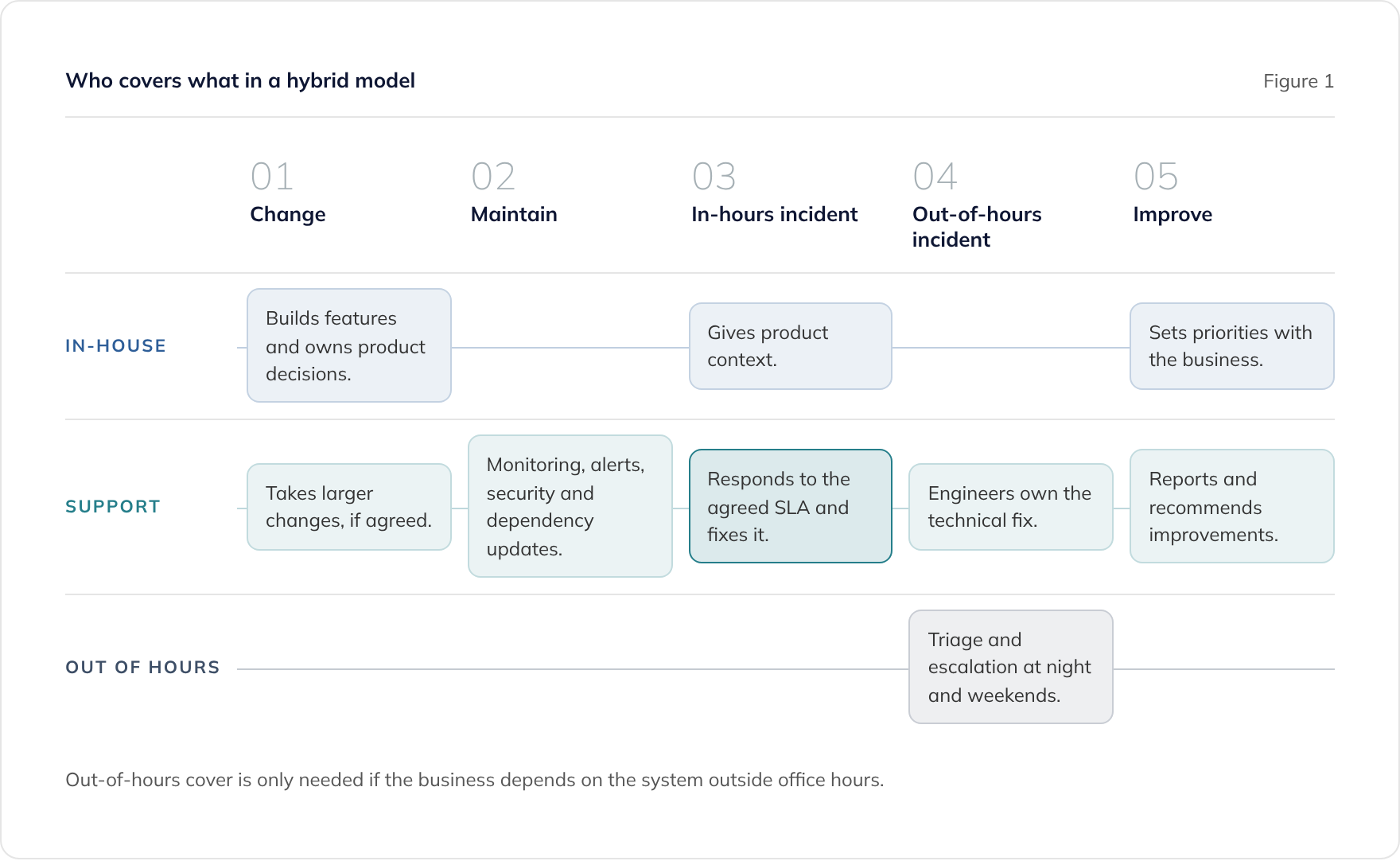
The hybrid costs more than either option on its own. In return, you get domain knowledge, breadth and cover, and you remove the risk of everything depending on one person.
Where should you start?
- Measure the workload. Count the hours each week that running the system takes, including monitoring, incidents, security updates and bug fixes. If it is under about 20 to 25 hours, a full-time hire is hard to justify.
- Decide what cover you need. If the business depends on the system out of hours, a single hire cannot provide that cover.
- Get an assessment. A maintainability review assesses the code and what it will cost to keep, and a Production Readiness Review checks an AI-built system before anyone supports it.
If your development team has left or is leaving, see our guide on what to do when your development team leaves. To discuss your situation, book a consultation.
Frequently asked questions
How much does managed application support cost?
Should we hire a DevOps engineer or use managed support?
Can one in-house hire provide 24/7 cover?
When should I hire in-house instead?
Can a managed support team also build new features?
Our app was built with AI tools. Does that change the decision?
Related guides
AI-Augmented Application Support: Custom AI for Better Outcomes
How custom, system-specific AI augments managed application support: automated DBA, tailored telemetry, infrastructure analysis, and log analysis for faster, cheaper resolution.
Tendering for a Long-Term Technology Partner: A Buyer's Guide
How to run a selection process when you need a partner to take over and develop a business-critical application estate, not just supply developers. Shortlisting, evaluation criteria, and the questions that separate suppliers.
Keeping Supported Software Secure: Advanced Security and AI Threat Intelligence
How managed support keeps software secure: GitHub Advanced Security, Detectify attack surface monitoring, AI code analysis, and threat intelligence, with reviewed remediation.