
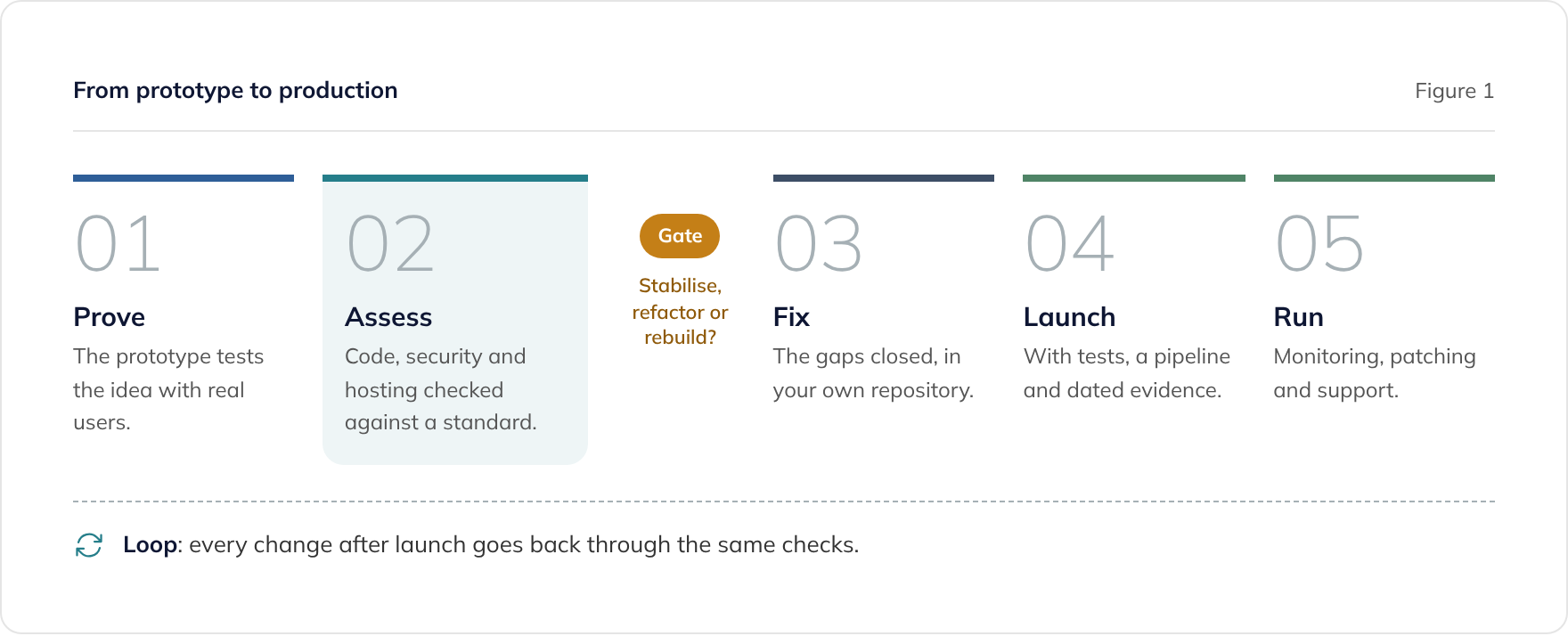
A prototype built with Lovable, Bolt, Replit or Cursor can prove an idea in days. Taking it to production means closing the gaps those tools leave: database access rules, secrets in the browser, missing tests, shared development and production data, and nobody accountable for the result. Start with an assessment against a recognised standard, then stabilise, refactor or rebuild based on what it finds. Our prototype to production service covers each step.
Why does a working prototype need more work?
A prototype is built to answer one question: is this idea worth pursuing? AI app builders answer it quickly, and that is a good use of them. A production system has to answer different questions. Can a customer see another customer’s data? What happens when the database is deleted? Who fixes it at 9pm on a Friday?
Those answers do not appear on screen during a demo, so a prototype can look finished long before it is. The work between the two is mostly invisible, which is why it is so often underestimated.
We have used these tools ourselves. Our AI Velocity Report for Q4 2025 records that we stopped using Replit and other dedicated vibe coding tools that quarter. Cursor with Opus 4.5 gave us better results and more control, and starting projects with a specification removed the head start the vibe coding tools had offered.
What goes wrong when AI-built software reaches production?
The same problems appear across tools, and several have been documented publicly. Each one maps to a check you can make on your own application, and our guide to security checks for vibe-coded apps sets them out tool by tool.
AI-generated code is often insecure by default
Veracode’s 2025 GenAI Code Security Report tested more than 100 large language models on 80 coding tasks. When a model could choose a secure or an insecure way to write the code, it chose the insecure option 45% of the time. The models failed to defend against cross-site scripting in 86% of cases. Veracode also found that larger models did not perform significantly better than smaller ones on security.
Database access rules are missing or wrong
Apps built with Lovable, and Bolt apps connected to Supabase, can talk to the database straight from the browser through Supabase. In that model, the key in the browser is public by design, and the database’s access rules are the security. Supabase’s documentation states that ‘a table in an exposed schema without RLS is readable and writable by any role with a grant on it.’ RLS is row level security, the rules that decide which rows each user can read or change.
In 2025, a researcher scanned 1,645 apps from Lovable’s public showcase and reported 303 endpoints across 170 projects with inadequate access rules. The exposed data included names, phone numbers, payment details and API keys. The issue was recorded as CVE-2025-48757. Lovable disputes the record, on the grounds that each customer is responsible for protecting their own application’s data. That position is the practical lesson: the platform will not secure your data for you.
Development work touches production data
In July 2025, SaaStr founder Jason Lemkin reported that Replit’s AI agent had deleted a production database, despite instructions to freeze code changes. Replit’s chief executive called it ‘unacceptable and should never be possible’. He said Replit had ‘started rolling out automatic DB dev/prod separation to prevent this categorically.’ Replit’s documentation now describes separate development and production databases for published apps.
The lesson applies to every tool. Whatever builds or changes your application should not be able to reach production data, and a backup only counts once you have restored it.
Secrets end up in the browser
Lovable’s security documentation states that ‘API keys and other secrets cannot be stored safely in client-side code.’ The researcher’s findings above included API keys and map service tokens. The quickest way to make a feature work is often to call a paid service straight from the page, which puts its key where any visitor can read it.
Built-in scans are a first check, not a review
Lovable now runs a quick scan on every publish, covering database access rules and vulnerable dependencies, and offers a deeper scan of the code that also looks for leaked secrets. Its documentation is clear about the limits: the tools ‘do not replace a thorough security review’ and ‘cannot guarantee complete security.’ A scanner can confirm an access rule exists. Only someone who understands what the application is meant to allow can confirm the rule is correct.
What does production-grade software need?
Production software needs the capabilities below, whichever tool wrote it. Our production readiness checklist for AI-built apps breaks them into individual checks mapped to OWASP ASVS (the Application Security Verification Standard) and Cyber Essentials Plus, and marks which ones you can check yourself.
Security
- Access rules enforced on the server or in the database, not only in the page
- No secrets in the code, the browser or the prompt history, and any that were exposed rotated
- Input validated on the server, and output encoded
- Dependencies scanned for known vulnerabilities
- Multi-factor authentication on every cloud, hosting and code account
Testing
- Automated tests for the business logic that matters most, checking results rather than just running
- End-to-end tests for the critical user journeys
- Tests that run on every change and block a merge when they fail
Deployment and operations
- An automated pipeline from repository to production, with a CI/CD process you can see
- Separate development, staging and production environments, with separate data
- Infrastructure defined as code, and a rollback you have tried
Monitoring and recovery
- Alerts when the application fails or slows down, sent to someone who knows what to do
- Structured logs, without secrets or personal data in them
- Automated backups stored away from production, with a tested restore
Ownership and accountability
- Your organisation owns the cloud, code repository and domain accounts
- The code lives in a repository you control, not only inside the builder’s platform
- A named person or supplier is responsible for the system once it is live
The last group is the one most often missing. Our pricing reflects it: the boundary for our AI-built software support tier is not whether AI wrote the code, but whether anyone was accountable for it.
What are the paths from prototype to production?
There are three, and the assessment tells you which one fits. The prototype’s quality, your data and your compliance requirements matter more than how the code was produced.
Stabilise
When it fits: the structure and data model are sound, and the gaps are in security, tests, deployment and monitoring.
What happens: we close the gaps in the existing code and keep its structure. A simple internal tool might be production-ready in three to four weeks.
Refactor
When it fits: the idea is right and parts of the code are worth keeping, but some components need rebuilding.
What happens: we keep what works, rebuild what does not, and use the running prototype as a specification. A customer-facing application with compliance requirements and complex integrations might take two to three months.
Rebuild
When it fits: a foundation choice is wrong for production, such as the data model, the sign-in approach or the hosting platform.
What happens: the prototype becomes the specification, and we build on production foundations from the start. The scope and timeline come from the assessment, and our pricing page shows current ranges.
How do you decide which path?
Answer four questions, ideally with an engineer who has read the code:
- Can another developer understand the code in a day? If so, stabilise. If it takes a week, refactor. If they cannot, rebuild.
- Does the data model reflect the business? If tables and relationships match how the business works, the foundation is sound. If they are a by-product of the tool’s defaults, the data layer needs work.
- Is the platform right for production? Check where the data is hosted, whether you can meet your data protection and residency obligations there, and whether you can export everything if you leave.
- How soon do you need to go live? Stabilising is fastest. If time is short, stabilise what you have and plan the deeper work in phases.
What if the prototype was made in Claude Design or as a Claude artifact?
A prototype made in Claude Design or as a Claude artifact is built to answer questions about flow, layout, and brand quickly. It is not built to be secure, maintainable, and reliable at scale, so the gaps above apply to it as they do to any other prototype. In our experience the tested design carries forward into the build, and the prototype code usually does not.
We start from the exported .zip project archive, because it holds the design’s source files and assets, not just a picture of it. We drop it into Claude Code to take the design into the build, then check the result against the design. For mobile and desktop apps we tend to use screenshots, and for web we may also use the source code or ask Claude to check directly in the browser.
Our guide to moving designs between Claude Design and Claude Code explains the method in full.
How does AI-augmented engineering speed this up?
The tools that built the prototype also speed up the work to make it production-ready. The difference is structure and review. 91.6% of our code is AI-authored, and 100% of it is reviewed by senior engineers and validated by ISTQB-qualified QA. That model is how we deliver 40 to 50% faster without lowering the bar for what reaches production.
In practice, AI helps with:
- Reading the codebase: mapping an unfamiliar prototype, its data flows and its gaps
- Writing tests: drafting tests for existing behaviour, which engineers then review and tighten
- Fixing patterns: applying the same fix across every place a weakness appears
- Infrastructure: generating pipelines and infrastructure as code for environments the prototype never had
- Documentation: producing the technical documentation a support team needs
Every change goes through human review before it merges. Our structured AI approach explains how.
Where should you start?
- Do not apologise for the code. The prototype did its job. If real users have not tried it yet, test it with them before the build.
- Move the code somewhere you control. Connect the project to a repository your organisation owns, and check who holds the cloud and domain accounts.
- Get an assessment. Our Production Readiness Review is £5,500, fixed, over two weeks, and gives you an evidence pack you can show customers. If the app is already failing in production, start with vibe coding rescue instead.
- Plan for life after launch. Production readiness is a milestone, not a finish line. Our managed support for AI-built software starts from £2,450 a month. This service covers AI-generated codebases we did not build.
If a customer is already asking for security evidence, our guides to penetration tests and production readiness reviews and to answering a security questionnaire when AI built your product cover the next steps. To talk through your situation, book a consultation.
Frequently asked questions
What is wrong with vibe-coded software?
Are the built-in security scans in Lovable or Replit enough?
Should I rebuild from scratch or refactor the prototype?
How long does it take to make a prototype production-ready?
How much does it cost to take a prototype to production?
Can a Claude Design prototype go to production?
Who owns the code after production hardening?
Related guides
Production Readiness Checklist for AI-Built Apps: OWASP ASVS and Cyber Essentials Plus
A production readiness checklist for AI-built apps, mapped to OWASP ASVS 5.0 and Cyber Essentials Plus, including what Cyber Essentials Plus does not cover.
Security Checks for Vibe-Coded Apps: Lovable, Bolt, Replit, Cursor and Claude Code
Security checks for apps vibe coded with Lovable, Bolt, Replit, Cursor or Claude Code: what to test yourself, tool by tool, and when to call an engineer.
DevOps Maturity: Where Does Your Team Stand and What Should You Fix First?
A practical DevOps maturity model with AI-augmented practices at each level. Self-assessment questions, DORA metrics, and a prioritised improvement path.