
Ask an agency to show how it designs, not only what it has built. Good answers name who does the design work, how ideas are tested with users, how accessibility is checked, and who owns the design files and design system at the end. If ownership is unclear in the contract, settle it before work starts.
A portfolio shows what an agency has built, but it says little about how the designs were made or what you will own at the end. This guide gives you the questions to ask, what good answers sound like, the red flags to watch for, and how ownership of design files works. It also includes our own answers.
It is part of our series on UX design for custom software. The ownership section is general information, not legal advice.
What should you ask about an agency’s design process?
These questions work in a first meeting or a written tender. Each one is something an agency with a real design practice can answer plainly.
- Who does the design work? Which roles, and how do they understand our users, our data, and our systems?
- How does design fit into the project? Is it a phase at the start, or does it run through the build?
- Which screens get design attention? The main journeys only, or every screen, including admin screens, error states, and reports?
- Where does AI help, and where do people decide? Which design tasks does AI do, and who reviews the results?
- How do you test designs with users? When, with whom, and what counts as evidence?
- How do you work with our brand? Can you work with our brand agency and within our guidelines? What do you need from them?
- Can you build from our own designs? What do you need from the files, and what happens when you find gaps?
- Which accessibility standard do you design to, and how do you check it?
- What happens to our research data? Particularly inside AI tools.
- Who owns the design files and the design system at the end? And how are they handed over?
What do good answers sound like?
Good answers are specific and describe a practice, not an aspiration. A few signs to listen for:
- Named roles and real tools. ‘Our business analysts and engineers design with Claude’ is more useful than ‘we have a creative process’.
- Design that runs through the build. If design stops when engineering starts, the screens nobody designed will be built anyway.
- Users in the loop. The agency can describe how users react to prototypes before the build, not only after launch.
- A clear split between AI and people. AI can do a lot of design work, but people should review every design and own the decisions.
- A standard and a method for accessibility. WCAG 2.2 AA, checked with automated testing and manual techniques, is a common, credible answer.
- Ownership that matches the code. Design files and the design system should be covered by the contract in the same way as the software.
How would we answer these questions?
We think suppliers should answer the questions they ask buyers to ask, so here are our answers.
- Who designs: design is done by our business analysts and engineers, working with AI. With good brand input from you or your agency, we do not need a separate designer.
- When: design runs through discovery and the build, and it is usually part of our legacy modernisation work too.
- Which screens: we apply UX to every screen on our current projects, not a sample.
- AI and people: AI is involved at every stage of our design process, and we design and prototype with Claude. People give the first input and feedback, and review every design.
- Brand: we work with clients’ brand agencies and within their brand guidelines.
- Your designs: we can build them to match pixel for pixel, although in our experience designing from your brand input with AI is now far more efficient.
- Accessibility: we design to WCAG 2.2 AA by default, and check it with automated testing, alongside standard techniques and tools.
- Cost: design is included in our discovery and build work rather than priced separately.
- Ownership: design files and the design system follow the same licence terms as the software itself.
What are the red flags in an agency’s design work?
Some warning signs are easy to spot once you know to look for them:
- No user involvement. Designs are approved by stakeholders but never tried by the people who will use them.
- Screens without states. Polished main screens, with nothing for errors, empty lists, loading, or different permissions.
- No accessibility evidence. The agency cannot name a standard or explain how it checks one.
- Design files kept back. You only ever see exported images, and the working files stay with the agency.
- AI output with no human review. Designs are generated and delivered without anyone checking them against your users, brand, and data.
- Design separated from the technology. Screens are drawn by people who never see the data or the systems, and the build team discovers the constraints later.
Who owns the designs, the design files, and the design system?
Ownership is set by the contract, so read it with design in mind, not only code.
The default position
Under UK copyright law, the author of a work is usually its first owner. Work made by an employee in the course of their employment belongs to the employer, as set out in section 11 of the Copyright, Designs and Patents Act 1988. Work created by an outside agency therefore stays with the agency unless the contract assigns it to you.
A licence, by contrast, gives you the right to use the work without owning it. GOV.UK’s guide to how copyright protects your work gives a plain-English overview.
What the contract should cover
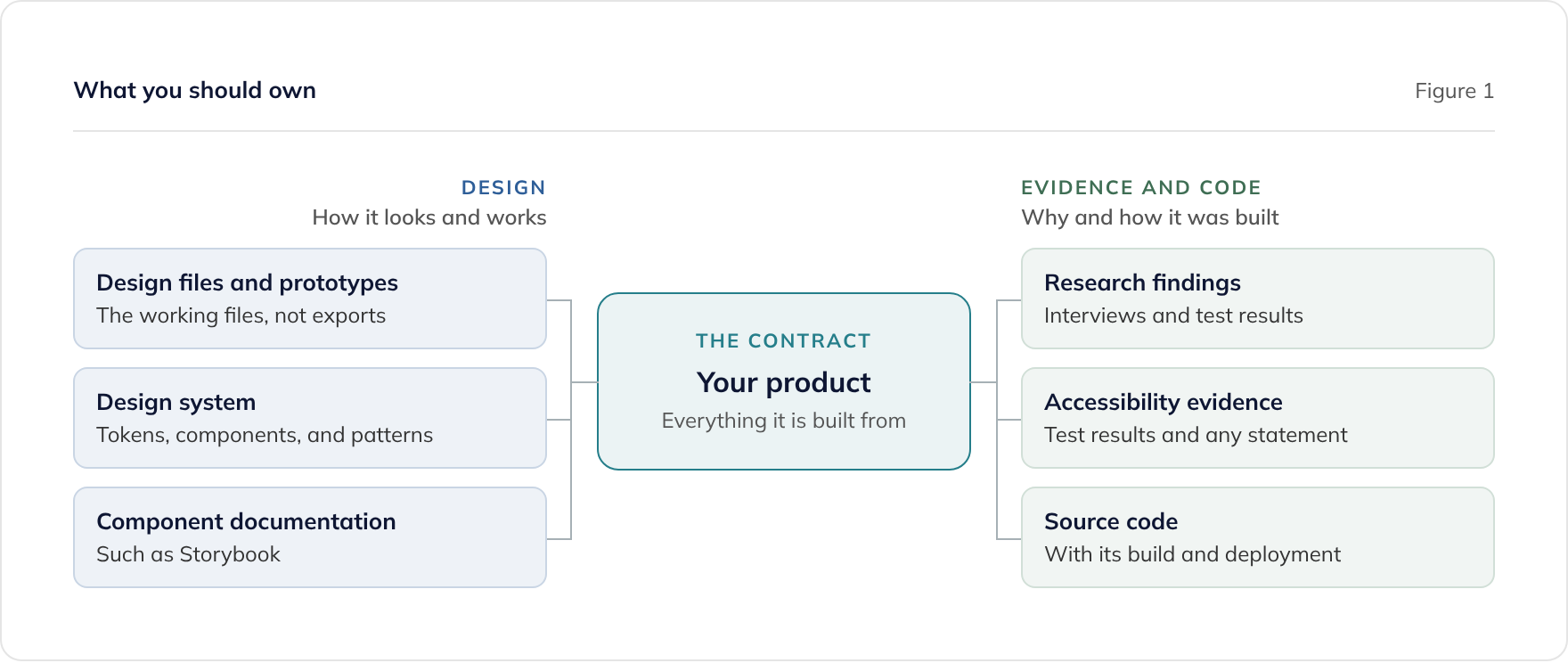
Make sure the contract names each of these, not just ‘the software’:
- Design files and prototypes
- The design system: tokens, components, and patterns
- Component documentation, such as Storybook
- Research findings and usability test results
- Accessibility evidence
- The source code
Our position
With us, design files and the design system follow the same licence terms as the software itself. Our guide to software IP licensing and source code handover explains those terms, and our software development contracts guide covers the wider agreement.
How should AI use in design be disclosed?
Ask about it directly, and expect a straight answer. A supplier that uses AI well in design should be comfortable explaining which tasks AI does, which tools it uses, who reviews the output, and what happens to your data.
Two things matter most. First, people should review every design, so the work reflects your users and your brand. Second, the contract should cover AI-assisted work in the same way as any other work, so ownership is not in doubt. Our guide on where AI helps in UX design and where people decide covers both, including UK GDPR for research data.
Where to go next
For the wider supplier decision, see our guides on choosing a software development partner in the AI era and how to evaluate a software development partner. For ownership questions beyond design, our founder’s checklist on owning your software is a good next step.
To ask us these questions directly, book a consultation.
Frequently asked questions
Who owns design files by default in the UK?
Should design files be in our own account?
What if the agency uses AI to generate designs?
How do we check an agency's accessibility claims?
Can we take the designs to another supplier?
Related guides
Can AI Do UX Design? Where AI Helps and Where People Decide
What AI does well in UX design, from card sorting to synthesis, where people must decide, and how to use research data safely under UK GDPR.
Accessible by Design: Building Software That Meets WCAG 2.2 AA
How to design accessible software from the start, what WCAG 2.2 AA means in practice, and what UK public sector accessibility regulations require.
AI-Friendly Brand Guidelines: What Your Brand Agency Should Give a Software Team
What your brand agency should give a software team so AI design tools such as Claude Design can apply your brand: palette, fonts, logos, and examples.