
QA and Testing Services
Software testing that keeps pace with AI-built code
Our QA practice covers manual and automated functional and regression testing, accessibility testing, load, stress and soak testing, static code analysis, and expert-led secure coding validation for AI-generated code. It runs inside our delivery and managed support work, so the team that finds a problem also fixes it.
Why testing has to change when AI writes the code
AI tools produce plausible code faster than anyone can read it line by line, so quality has to come from layers of checks, each built to catch a different kind of fault, with a named person accountable for each. Automated checks prove exactly what each test asserts. People judge the design, the usability and whether the feature does what the business needed.
That is how we work. In our own delivery, 91.6% of our code is AI-authored, and 100% of it is reviewed by senior engineers and validated by ISTQB-qualified QA. The example below follows one story through the four stages of testing, from the build to sign-off.
What our QA practice covers
The same checks apply to code we write and to code we did not build, including code written with AI tools.
Function: Functional testing
Function: Regression testing
Security: Static code analysis
Security: Secure coding validation
Accessibility: WCAG 2.2 AA testing
Performance: Load, stress and soak testing
Two kinds of testing sit outside our practice. We do not carry out penetration tests: when you need one, commission it from a CREST-accredited tester, and we fix its findings alongside our own. Our accessibility testing is automated testing plus standard techniques and tools, not a manual audit with assistive-technology users. Our guide to penetration tests and readiness reviews explains which to do first.
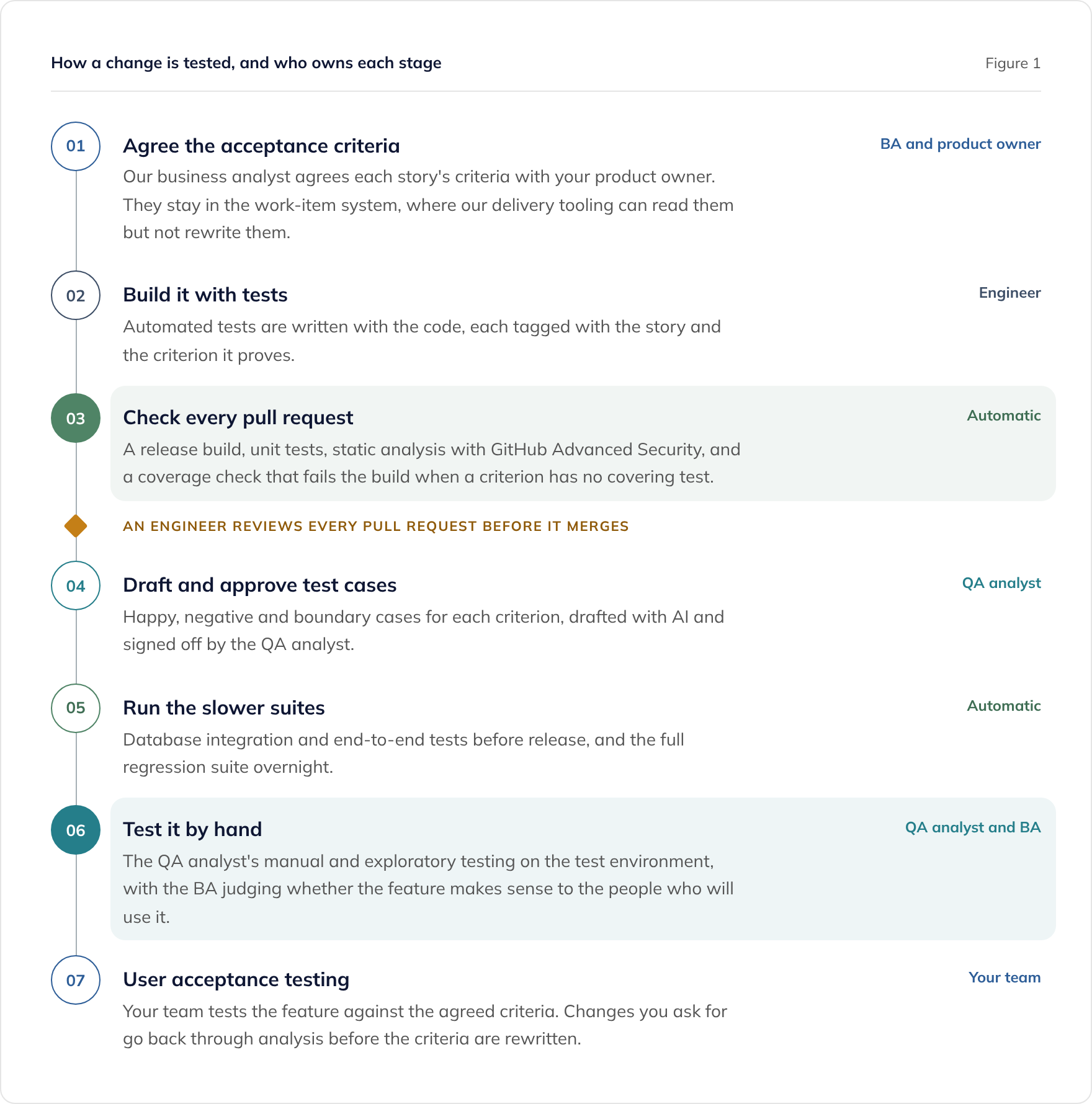
How a change is tested, from criteria to release
Cheap, fast checks run first and slow, thorough ones later, so the people at the end spend their time on judgement rather than on problems a machine could have found. The exact suites vary by project.
Where our testing runs
We test as part of building and supporting software, rather than as a separate team handed the code at the end.
Custom software development
In software we build for you
Testing is part of how every project is delivered. Every change is reviewed by senior engineers and validated by ISTQB-qualified QA before release.
Managed application support, from £1,590 a month
In software we support
Where automated regression suites exist, we maintain them as part of managed support. Where they do not, our maintainability review recommends closing the gap, with the priority set by how critical the system is.
Production Readiness Review, £5,500 fixed
In software someone else built
A two-week review of code we did not build, including AI-generated code: static analysis, secure coding validation, an accessibility scan, a dependency audit and a test coverage baseline.
What testing found on a change we measured
We measured one change closely: two complex, linked user stories on one of the booking platforms we build, which went from open questions to two merged pull requests in 15 hours 35 minutes. Across the session, the unit suite of about 2,400 tests ran twice with no failures, and the combined smoke and story tests, around 160 of them, passed in full.
Testing still found a fault the build gates had missed. During QA on the second story, a smoke test from an earlier, unrelated story failed. The first story had introduced a new kind of history entry, the second story's test created one, and the older test did not recognise it. Neither the story's own tests nor the smoke tests on their own exposed it. When a fault gets past a layer like this, we fix it and then change the layer that should have caught it, and several of the rules and guard tests in our delivery harness started that way.
The full account is in Anatomy of an AI Change, and our post on how we keep quality high when AI builds at speed sets out who owns each of the twelve layers that checked it.
How AI speeds up our testers
AI takes the preparation work, and our testers spend the time it saves on the testing that needs judgement.
Test cases from acceptance criteria
Claude drafts happy, negative and boundary cases from each criterion, and the QA analyst reviews and approves every one before it joins the test suite.
Bug reports that point at the cause
A Claude skill with access to the source code turns a short description into a structured ticket, with its view of where the problem starts and what the fix might be.
Release risk analysis
AI run against the release branches shows what has actually changed and where the risk sits, so testing time goes where it is needed most.
Acceptance criteria checks in the pipeline
An automated check reads the acceptance criteria and evaluates the code against them before the work reaches manual testing.
Our QA team lead's account of quality at the speed of AI describes how these fit into a working week.
Seen enough? Let's talk through your requirements.
Book a free consultationFrequently asked questions
What testing do you offer?
Our QA practice covers manual and automated functional and regression testing, accessibility testing, load, stress and soak testing, static code analysis, and expert-led secure coding validation for AI-generated code. We run it as part of our delivery and managed support work, so the team that finds a problem can also fix it.
Can we buy testing on its own?
We do not offer testing as a standalone resourcing service. If you need an independent view of software someone else built, including AI-generated code, the Production Readiness Review is a fixed-fee, two-week review at £5,500 that ends in an evidence pack. Ongoing testing then runs through managed support or a development engagement.
Who does the testing?
Three roles share it. Engineers direct the automated tests that prove each acceptance criterion. Our ISTQB-qualified QA analyst designs the approach to test cases, signs off every case and runs the manual and exploratory sessions. A business analyst agrees the criteria with your product owner and joins the manual session to judge whether the feature makes sense. In our own delivery, 91.6% of our code is AI-authored, and 100% of it is reviewed by senior engineers and validated by ISTQB-qualified QA.
How do you test AI-generated code?
The same way we test any code, with two extra safeguards. The acceptance criteria live in the work-item system, where our delivery tooling can read them but not rewrite them, so the code is always measured against something the AI did not write. And senior engineers validate AI-generated code against OWASP ASVS, with a reviewer who never wrote the change. Our post on keeping quality high when AI builds at speed shows every layer on a measured change.
Do you carry out penetration testing?
No. Our secure coding suite is built from the findings of penetration tests on previous projects, so issues that real tests have found are checked for on every review. If a customer or insurer needs a penetration test, commission it from a CREST-accredited tester, and we can fix its findings alongside ours.
Do you carry out accessibility audits?
We test against WCAG 2.2 AA with automated tools, plus standard techniques and tools. That is not the same as a manual audit or testing with assistive-technology users. If a buyer or regulator asks for one of those, commission it from a specialist accessibility auditor, and we can fix what it finds.
Can you load test our system?
Yes, as part of delivery or managed support. We use Azure Load Testing for load, stress and soak testing, to find and fix scalability problems, design scaling strategies such as Kubernetes autoscaling, and size infrastructure and cloud SKUs for performance and cost.
Go deeper
AI-Augmented QA
How quality assurance keeps pace with AI development, and where human judgement still leads.
Checking AI-Written Tests
Mutation testing and evals, to check that tests test the right things rather than agree with the code.
Acceptance Testing in Software Contracts
How UAT, acceptance criteria and sign-off work in a UK software contract.
Accessible Software Design
What UK accessibility law and WCAG 2.2 AA mean for the software you commission.
Production Readiness Checklist
45 checks mapped to OWASP ASVS and Cyber Essentials Plus, with an interactive version.
Penetration Test or Readiness Review?
What each finds, which to do first, and how to choose a tester.
Testing is one part of our software assurance services, alongside readiness reviews and managed support.
See how AI is changing how we build software
Our quarterly AI Velocity Report tracks real delivery metrics from live projects: how much of our code is AI-authored, how delivery timelines compare to baseline, and which tools are making a measurable difference. No marketing spin, just honest data from a team that builds software every day.
Read the latest AI Velocity ReportTalk to us about testing your software
Book a consultation and we will tell you how we would test your system, what we would check first, and what it would cost.
Book a consultationor call 01202 006729