
How Booking Waitlists Should Work: Queues, Positions, and Promotion Design
A good waitlist is a first-class part of the booking model, not a bolt-on list. Joining should be atomic with the capacity check, entries should carry an honest queue position, queue sizes should be bounded and configurable, and promotion (what happens when a place frees) should follow a deliberate model: automatic booking, a time-limited offer, or staff control. This guide sets out the design, the trade-offs, and what to demand from any booking platform you evaluate.
Why do waitlists matter more than they look?
Because a full session is your best product telling you it is underprovisioned. When a class fills, the demand does not stop; it just stops being visible unless you record it. A waitlist converts that invisible demand into three concrete assets:
- Recovered revenue: cancellations are routine, and a queue turns each one into a filled place instead of an empty one.
- Retention: “you are third in the queue” keeps a customer engaged; “session full, try again” sends them to a competitor.
- A planning signal: waiting counts per session are the most honest demand data an operator has. They tell you exactly where to add capacity.
Despite that, waitlists are one of the most commonly botched features in booking software, usually because they are implemented as an afterthought: a separate list, disconnected from capacity, with promotion logic that races or relies on a member of staff remembering.
What should a waitlist entry actually be?
A waitlist entry should be the same kind of record as a booking, with a different status. The moment a waitlist lives in its own bolt-on table with its own rules, it drifts: entries survive after the customer books elsewhere, counts disagree with reality, and promotion logic has to stitch two systems together.
The robust model treats the customer’s relationship to a session occurrence as one record with a status lifecycle:
- Confirmed, cancelled, no-show, checked-in, completed: the booking states.
- Waitlisted: the same record type, with a queue position.
This buys you several properties for free. The waitlist inherits the booking system’s audit trail. Admin screens show bookings and queue members in one view. Duplicate prevention works identically (a customer cannot hold both a booking and a queue place). And promotion is a status transition, not a cross-system copy.
The Booking Engine accelerator models it exactly this way: waitlisted is a first-class status alongside confirmed, cancelled, and no-show, each entry carries an explicit queue position, and every occurrence tracks a live waiting count next to its booked count.
How should joining the waitlist work?
Atomically, inside the same operation that discovered the session was full. The naive flow (booking fails, then the app offers a waitlist button, then a second request joins the queue) has a race in the gap: two customers can be told “you are position 3” and both believe it, or a place can free between the two steps and the customer joins a queue for a session that now has space.
The correct sequence is one serialised transaction:
- Check capacity (confirmed bookings plus unexpired checkout holds against the limit).
- If there is space, reserve it, as described in our guide to reservation and release in checkout flows.
- If there is not, and the session allows waitlisting, write the waitlist entry at the back of the queue and increment the waiting count, in the same transaction.
The customer gets one of two definite answers from one request: a held place, or a queue position. This is how the accelerator’s public reserve endpoint behaves; the full-session path assigns the next queue position and updates the waiting count under the same per-occurrence lock that guards bookings. The concurrency reasoning behind that lock is covered in handling high-demand bookings without overselling.
What are the promotion models when a place frees?
Promotion is the half of waitlist design where products differ most, and the right choice depends on payment and audience. There are three honest models.
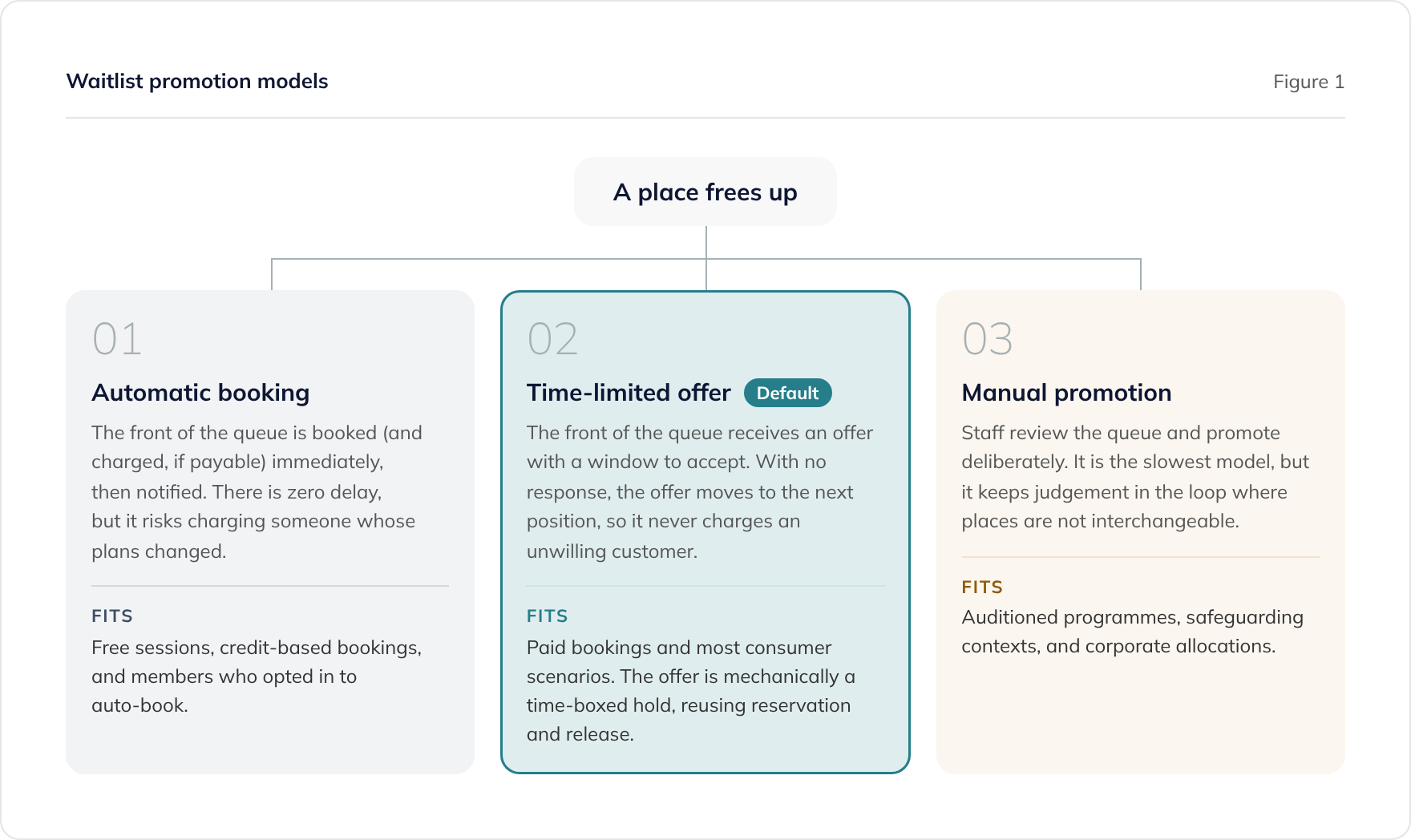
Two design notes cut across all three models. First, a time-limited offer is mechanically the same thing as a checkout hold: a place is held for one named person with an expiry, then released. A platform with solid reservation-and-release mechanics already has the machinery, which is a useful architectural test of any product you evaluate. Second, promotion must consume the queue atomically, exactly like joining it: if two places free at once, positions one and two should be promoted once each, not raced.
Be equally deliberate about the notification channel. An offer nobody sees is a place held hostage for the length of the window, so offers should go out on a channel with fast read times (push or SMS ahead of email) and state the deadline plainly.
Should the queue be bounded?
Yes. An unbounded waitlist flatters the operator and lies to the customer. Position 40 on a twelve-place class is not a prospect, it is a mailing list entry collected under false pretences. Meanwhile staff views fill with queues that will never clear, and the demand signal gets noisier rather than stronger.
Make the maximum queue size a configuration value per service or class, not a global constant. A weekly class with steady churn can justify a deep queue; a one-off workshop cannot. The accelerator exposes this as a per-service waitlist size setting, alongside a per-session toggle for whether waitlisting is allowed at all, so the queue policy matches the product being sold.
When the queue is full, say so honestly. “The waitlist for this session is full” is a better customer experience than an ever-growing queue with imaginary odds, and it preserves the meaning of the positions you have issued.
What should members and staff see?
The queue must be transparent in both directions, and the numbers must be live, not batch-updated.
- Members should see their position when they join, and ideally as it changes. A position is a promise; if the system cannot state it, the queue is not really ordered.
- Staff should see the waiting count next to the booked count on every occurrence, in the same view. That pairing (10 booked, 4 waiting) is the day-to-day demand dashboard.
- The business should be able to report on waiting counts across sessions, venues, and time. Recurring queues on Tuesday evenings are an instruction to open another Tuesday session.
The data model makes this cheap or expensive. Where waitlisted entries are first-class booking records with positions, and each occurrence maintains a live waiting counter, every one of these views is a simple read, which is the approach the Booking Engine accelerator takes.
How should you evaluate a waitlist implementation?
Ask for demonstrations against the failure modes above, in the same demonstrate-not-describe spirit as our franchise software buyer’s guide:
- The race test: two customers hit a full session simultaneously. Both should get definite, distinct queue positions.
- The duplicate test: a waitlisted customer tries to join again. They should get their existing position back, not a second entry.
- The bound test: where is the maximum queue size configured, and what does the customer see when it is reached?
- The promotion test: free a place and watch what happens. Which model runs, is it atomic, and what is the audit trail?
- The visibility test: show waiting counts live in the staff view, and show a report of queues across sessions.
A vendor who hesitates on the promotion test deserves particular scrutiny; it is the half of the feature most often left as a manual process behind an automated-sounding name.
Where does this fit in a wider booking platform?
Waitlists sit on top of the same foundations as everything else in bookings: honest capacity records, atomic state transitions, and queue mechanics that never race. If those foundations are sound, a waitlist is a natural extension; if they are not, it is another place to lose customers.
The Booking Engine accelerator provides those foundations as a product: waitlisted as a first-class status with explicit queue positions, atomic joins under the same lock that guards bookings, per-service queue-size configuration, and live waiting counts on every occurrence. It ships under a perpetual source-code licence, so the queue behaviour is inspectable and adaptable. For requirements beyond any packaged product, our custom software development service starts from the same patterns.
Book a waitlist and capacity review
If your sessions sell out but your revenue does not follow, or your queues live in a spreadsheet next to the booking system, we will happily map the gap. Bring your current flow and we will show you where demand is leaking and what a first-class queue would recover.
No pitch, no obligation. If your current setup is sound, we will tell you.
Frequently asked questions
What should happen when someone joins a booking waitlist?
How should a waitlist decide who gets a freed place?
Should a waitlist have a maximum size?
Is a waitlist entry the same as a booking?
What do waitlists tell you about demand?
Related guides
Claude Code for .NET Developers: A Practical Getting Started Guide
Getting started with Claude Code for C# and .NET. Installation, IDE integration, pre-approved command setup, cloud agents, and practical .NET workflows.
Data Protection by Design: The Standard Features Every Compliant System Needs
Data protection by design is an engineering discipline, not a policy document. This guide sets out the standard software features every GDPR-compliant system needs, and how to build them in from the first line of code.
Data Subject Rights, Retention and Erasure: The Engineering
Subject access, portability, and the right to erasure are software features with statutory deadlines, not favours. This guide covers how to build them, including retention engines, crypto-shredding, and erasure that keeps the audit trail.