
Reservation and Release in Checkout Flows: How Booking Systems Should Hold Places
When a customer starts checkout, the system should place a time-boxed hold on the place (typically 15 minutes) so it cannot be sold twice while they pay. Confirmation converts the hold into a booking atomically; abandonment simply lets the hold expire. The reliable pattern is lazy expiry: availability checks ignore lapsed holds, so places free themselves without depending on a background job. This is how the Booking Engine accelerator implements checkout, and this guide explains the design so you can evaluate or build one.
Why do booking checkouts need reservation and release?
Because payment takes time, and capacity is finite. Between a customer choosing a place and their payment settling, there is a window of one to several minutes. Without a hold, two customers can both pass the availability check for the last place, both pay, and one of them gets a refund and an apology.
The reverse failure is just as damaging. If the system claims the place permanently at the start of checkout, every abandoned basket removes real capacity. A popular class can look full for hours while nobody has actually bought the remaining places.
Reservation and release is the middle path:
- Reserve: when checkout starts, hold the place against capacity for a fixed window.
- Confirm: when payment completes, convert the hold into a confirmed booking.
- Release: if the window lapses without payment, the hold stops counting and the place is sellable again.
Get these three transitions right and overselling and phantom fullness both disappear. Get either wrong and you will be handling refunds or losing revenue.
What states should a reservation move through?
Model the hold as an explicit record with a status and an expiry timestamp, not as a decremented counter. A counter cannot tell you whose hold it is, when it lapses, or whether it was ever confirmed.
A minimal, robust state model has four states:
- Available: no record exists; the place is open to anyone.
- Reserved: a hold exists for a named customer with an expiry time (for example, now plus 15 minutes).
- Confirmed: payment completed inside the window; the hold became a booking and the booked count incremented.
- Released: the window lapsed or the customer cancelled; the hold no longer counts against capacity.
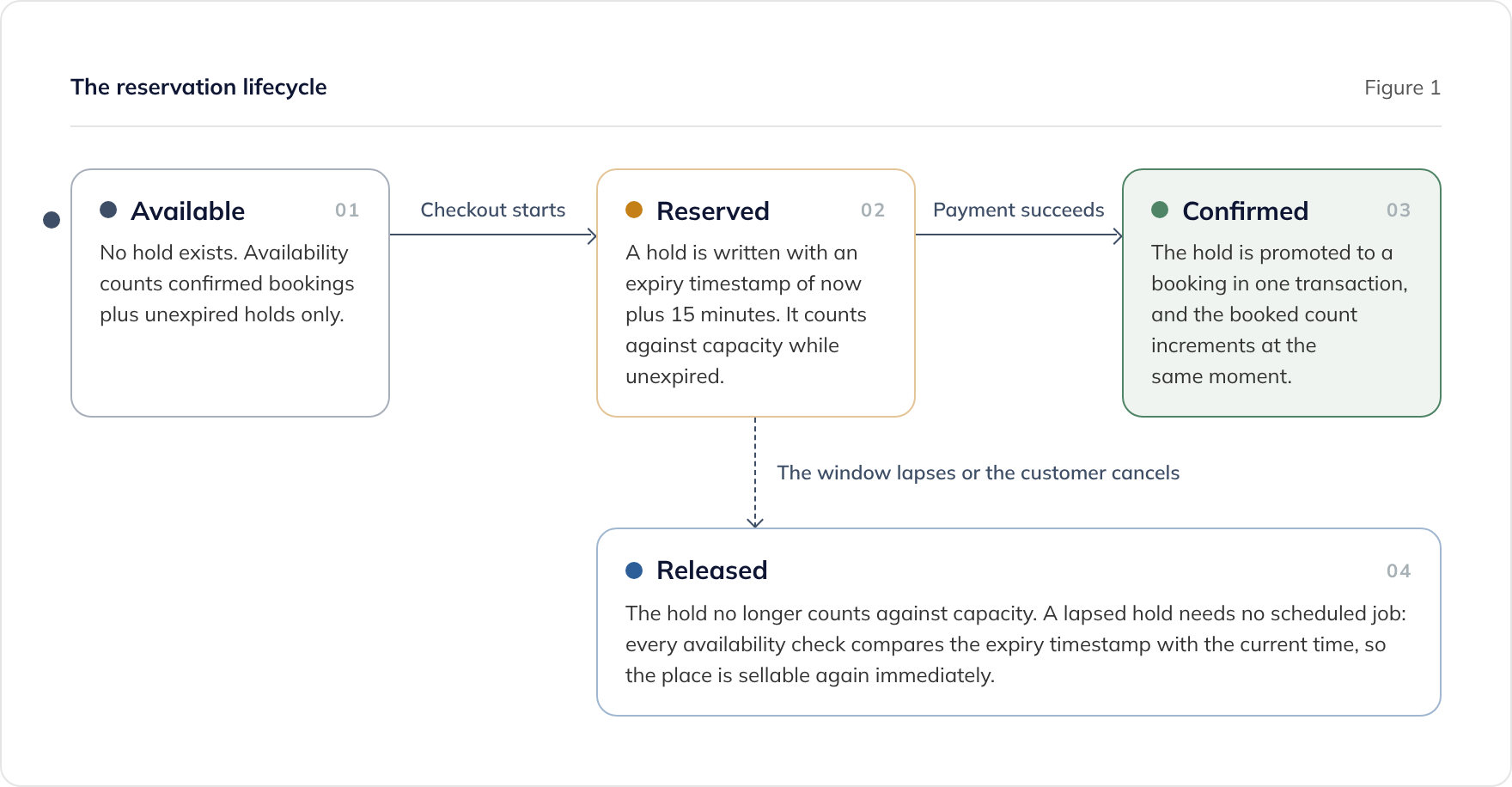
Two details in this model do most of the work. The expiry is a timestamp on the record, not a timer in application memory, so it survives restarts and works across servers. And confirmation is a state transition with rules, not a blind update, so an expired hold can never silently become a booking.
How should the reserve step behave?
The reserve step must check capacity and write the hold as one atomic action. If the check and the write are separate steps, two customers can pass the check together and both get holds for the last place. In a SQL-backed system, the standard technique is to serialise access per bookable item (for example with a row-level update lock on the occurrence row) so concurrent callers queue for a few milliseconds rather than racing.
The capacity question the reserve step asks should be: are confirmed bookings, plus holds that have not yet expired, still below capacity? Counting unexpired holds is what prevents double-selling. Ignoring expired ones is what prevents phantom fullness.
Three more behaviours are worth demanding from any implementation:
- Idempotency per customer: if the same customer taps “book” twice, they should get their existing hold back, not a second one. A uniqueness constraint on the customer-and-occurrence pair enforces this at the data layer.
- A clear expiry contract: the response should tell the customer how long they have (and the UI should show a countdown), with the window configurable per deployment rather than hard-coded.
- A full-and-waitlist path: if capacity is taken, the same atomic step can offer a waitlist position instead. See our guide on how booking waitlists should work for that half of the flow.
In the Booking Engine accelerator, this is exactly how the public reserve endpoint works. The capacity check and the hold write happen inside one serialised transaction, holds carry an expiry timestamp (15 minutes by default, configurable), and repeat calls for the same customer return the existing hold.
How should release actually work?
The reliable answer is lazy expiry: expired holds are excluded by every availability check, so release is a property of how you read the data, not a job you have to run. The moment a hold’s expiry timestamp passes, it no longer counts against capacity. Nothing has to happen for the place to become sellable again.
This matters because the alternative, a scheduled sweeper that deletes expired holds, turns a background job into a single point of failure. If the sweeper stalls for an hour, every abandoned checkout in that hour holds a place hostage. Sweepers also create a race at the margin: a hold can be mid-deletion at the same moment its owner completes payment.
The sensible architecture uses both, with distinct responsibilities:
- Lazy expiry for correctness: availability and reserve logic filter holds by expiry timestamp. This is the mechanism that guarantees places free up on time.
- A sweep for housekeeping only: a periodic job may close out lapsed hold records so reporting and admin views stay tidy. If it stops running, nothing oversells and nothing stays blocked.
When you evaluate a booking product, this is a revealing question to put to the vendor: “if your background jobs stop, do abandoned checkouts keep places blocked?” The answer tells you where release really lives.
Why must confirmation re-check the reservation?
Because payment outcomes arrive late, and the world may have changed. A customer can complete 3-D Secure authentication two seconds before their hold expires and the webhook can land two seconds after. If confirmation blindly flips the record to confirmed, you have sold a place the system may already have given to someone else.
Confirmation should be a guarded, atomic transition:
- If the hold exists and is unexpired, promote it to confirmed and increment the booked count in the same transaction.
- If the hold has expired, refuse the confirmation with an explicit “reservation expired” outcome so the caller can re-reserve or refund.
- If the hold is already confirmed, return success again. Payment providers retry webhooks, so confirmation must be idempotent.
The refusal path deserves real product thinking, not just an error code. The kindest behaviour is to attempt an immediate re-reserve: if the place is still free, the customer never knows the hold lapsed. Only if the place has genuinely gone should they see an apology and a refund. Either way, that decision belongs in one place at the API layer, not scattered across each front end.
How does this pattern change at high demand?
The mechanics stay the same, but the pressure moves to the margins: hundreds of holds being created and expiring around a fixed capacity, all contending for the same rows. The serialisation strategy, hold length, and retry behaviour start to dominate the customer experience.
Shorter holds, honest queue feedback, and a design that never trusts an unguarded read all matter more at scale. We cover that end of the problem, including on-sale spikes and last-place races, in the companion guide on handling high-demand bookings without overselling.
What should you look for when evaluating a booking system?
Use these as demonstration items, not tick-box questions. Ask the vendor to show you each behaviour on a live system, the same way our franchise software buyer’s guide recommends for every claimed capability.
- Show a hold being created: start a checkout and show the place counting against availability for other customers immediately.
- Show the expiry: abandon the checkout and show the place becoming available again at the window boundary, with no manual intervention.
- Show a refused confirmation: complete payment after forcing an expiry, and show the system refusing rather than overselling.
- Show idempotency: replay the confirmation and show that it does not double-book or double-count.
- Show the configuration: where is the hold window set, and can it differ per deployment?
A vendor who can demonstrate all five has built reservation and release properly. A vendor who talks about “real-time syncing” instead has probably built a counter and a sweeper.
Where does this fit in a wider booking platform?
Reservation and release is one slice of checkout. Around it sit capacity modelling, waitlists, booking policies, and payment orchestration, and the same design principles (explicit state, atomic transitions, no trust in background jobs) apply to each.
The Booking Engine accelerator packages these patterns as a production platform: time-boxed reservation holds, guarded atomic confirmation, per-occurrence capacity with live booked and waiting counters, and positioned waitlists. It is delivered as a perpetual source-code licence, so the checkout behaviour is yours to inspect and adapt. If your booking flow has requirements no off-the-shelf product fits, our custom software development service builds on the same foundations.
Book a booking-flow review
If your current system oversells at the margins, or holds places hostage after abandoned checkouts, we will happily take a look. Bring your booking flow and we will map where reservation, release, and confirmation actually live in it, and what fixing the gaps would involve.
No pitch, no obligation. If your current setup is sound, we will tell you.
Frequently asked questions
What is a reservation hold in a booking checkout?
How long should a checkout hold a booking reservation?
What happens if a customer abandons checkout with a place reserved?
Should a reservation system use a scheduled job to release expired holds?
What should happen if payment succeeds after the reservation has expired?
Related guides
Claude Code for .NET Developers: A Practical Getting Started Guide
Getting started with Claude Code for C# and .NET. Installation, IDE integration, pre-approved command setup, cloud agents, and practical .NET workflows.
Data Protection by Design: The Standard Features Every Compliant System Needs
Data protection by design is an engineering discipline, not a policy document. This guide sets out the standard software features every GDPR-compliant system needs, and how to build them in from the first line of code.
Data Subject Rights, Retention and Erasure: The Engineering
Subject access, portability, and the right to erasure are software features with statutory deadlines, not favours. This guide covers how to build them, including retention engines, crypto-shredding, and erasure that keeps the audit trail.