
Enterprise REST API Development Services
REST APIs that developers actually want to use
We design and build REST APIs that are clean, well-documented, versioned from day one, and deployed to Azure with security built in. Whether you need a public developer API, an internal microservice interface, or a third-party integration surface, we deliver APIs that stand the test of time.
Contract-first REST API development
Contract-first API design
RESTful resource modelling
Authentication & authorisation
Versioning & backwards compatibility
Documentation & developer experience
Testing, load testing & contract validation
REST API experience you can verify
Public REST API delivery experience
We have taken a customer from zero to a live, publicly accessible REST API managed through Azure APIM, including contract design, security policy, developer portal, and load testing.
Azure-native deployment
Our REST APIs run on Azure App Service, Azure Functions, or AKS, with managed identity, private endpoints, Application Insights instrumentation, and CI/CD pipelines as standard.
Government API track record
We have enhanced the API layer of the UK Livestock Unique Identification System, a legally mandated national service, improving security, flexibility, and interoperability.
Standards-driven, not over-engineered
We follow REST conventions rigorously and resist the temptation to over-engineer. Clean naming, correct status codes, proper error bodies, and sensible pagination, the fundamentals that make an API a pleasure to consume.
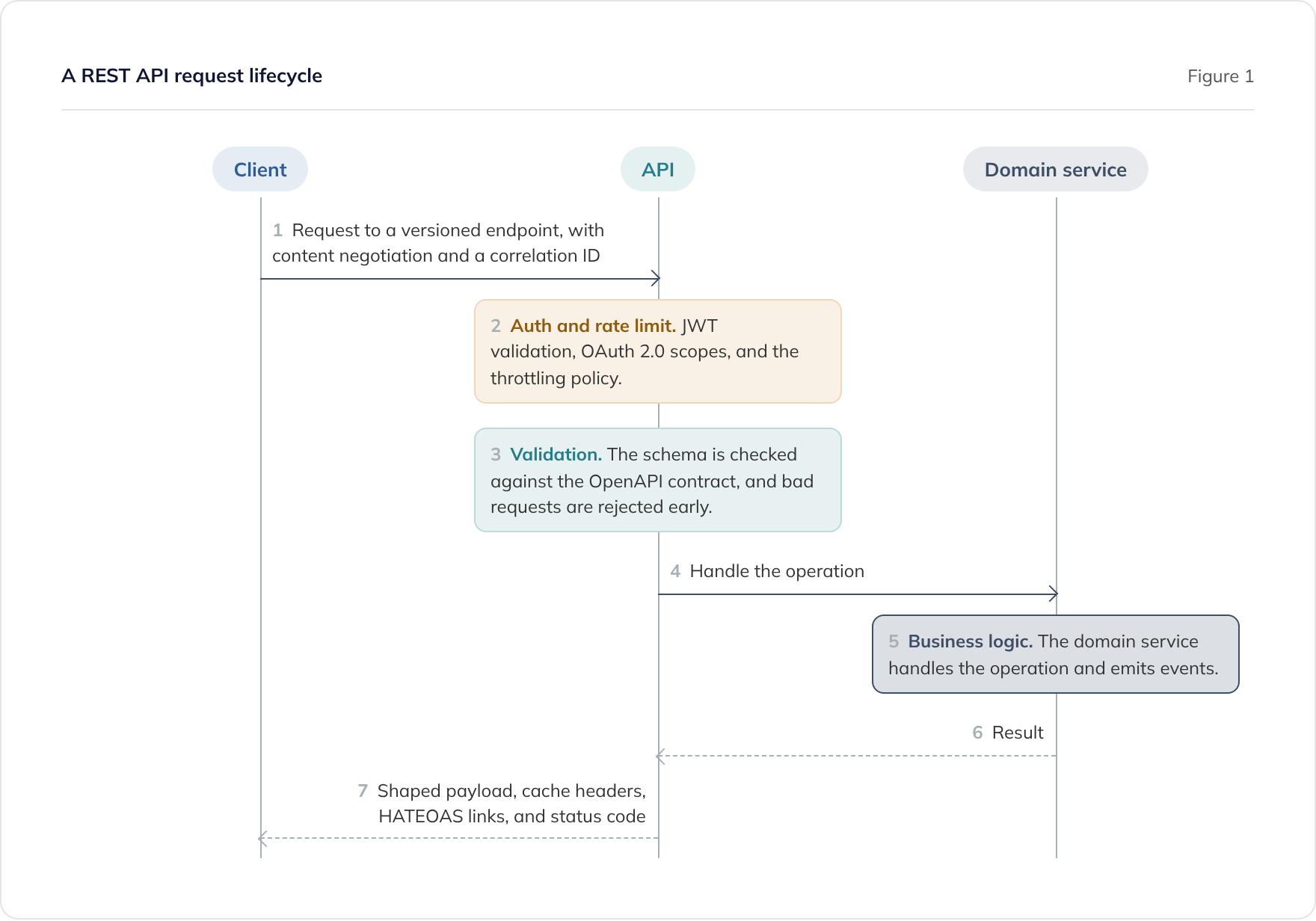
REST API request lifecycle
How a client request flows through authentication, validation, and caching to the response.
Our REST API development process
A spec-first approach that keeps your consuming teams unblocked from day one.
Requirements & API Contract Design
We work with your team and representative consumers to document requirements and produce an OpenAPI specification. Endpoints, resource models, auth flows, error schemas, and versioning strategy are all agreed before build starts.
Build & Mock-First Development
We generate a mock server from the OpenAPI spec on day one, giving your consuming teams something to build against immediately. The real implementation is built in sprint cycles with regular demos and contract-compliance checks.
Security Review, Testing & Documentation
We run automated contract tests, integration tests, and a security review covering OWASP API Top 10 considerations. Interactive documentation is generated from the spec and reviewed with stakeholders before launch.
Deployment & Launch
We deploy via CI/CD to your Azure environment, configure Azure APIM if in scope, and run final load tests. Post-launch, the API is monitored through Application Insights with alerting configured for error rate and latency thresholds.
Seen enough? Let's talk through your requirements.
Book a free consultationFrequently asked questions
What is the difference between REST and GraphQL? Which should I choose?
REST suits the majority of public APIs, webhook receivers, and CRUD-heavy backends, because it's simpler to cache, easier to reason about, and supported by every HTTP client on the planet. GraphQL is better when your clients have varied, complex data needs across related entities, typically mobile and web front-ends. See our GraphQL API Development page for more detail. In many systems, REST and GraphQL coexist.
Should my REST API go through Azure API Management?
If you have external consumers, need rate limiting, want centralised auth enforcement, or plan to expose multiple APIs, yes. APIM gives you a governed, observable API surface without polluting your backend with cross-cutting concerns. See our Azure API Management page.
Do you write OpenAPI specs first, or code first?
We prefer spec-first for any API with external consumers or parallel development teams, because it surfaces contract issues early and allows mock servers to be generated immediately. For purely internal APIs with a single consumer we may be more pragmatic, but we always produce an OpenAPI spec as a deliverable.
How do you handle breaking changes to an API?
We implement versioning from day one (/v1/, /v2/) and maintain a deprecation policy. Breaking changes are communicated through response headers (Deprecation, Sunset), documented in the developer portal, and given a supported sunset window before the old version is retired.
Can you take over an existing REST API that wasn't built by you?
Yes, we frequently take on inherited APIs. We start with a review of the existing codebase, spec, security posture, and test coverage, then produce a remediation plan before beginning any new feature work.
See how AI is changing how we build software
Our quarterly AI Velocity Report tracks real delivery metrics from live projects: how much of our code is AI-authored, how delivery timelines compare to baseline, and which tools are making a measurable difference. No marketing spin, just honest data from a team that builds software every day.
Read the latest AI Velocity ReportExplore the wider integration picture
Ready to build a REST API your consumers will love?
Book a free consultation with one of our API specialists to discuss your requirements, audience, and what a contract-first REST API project looks like with Talk Think Do.
Book a free consultationor call 01202 006729