
AI-Assisted .NET Modernisation
Modernise legacy .NET at agentic speed, without losing control
We use Claude Code under enforced guardrails to speed up the mechanical work in framework migrations, WinForms rebuilds, and large stored procedure estates. Senior .NET engineers make the architectural and business decisions. We stay on the Microsoft stack, use Claude-native tooling, and publish the evidence for how it performs.
Legacy .NET estates share three hard problems, and AI has changed the cost of solving each one
Framework versions age out of support, desktop applications cannot reach the web, and business rules hide in sprawling stored procedure estates. Each of these used to mean a year-long programme. Agentic tooling now speeds up the mechanical work, and our job is to keep quality and security intact while it does.
The version clock
.NET Framework 4.x receives security patches only, the talent pool is shrinking, and every quarter of delay makes the eventual migration more expensive. Much of the migration work is mechanical, and that is the work agents speed up most.
The desktop trap
WinForms applications are usually tied to desks on the corporate network, and there is no conversion path to the web. A rebuild used to be the risky option, but agents that analyse the old code and generate the new front end have changed that calculation.
The database within
Hundreds of stored procedures can hold business rules that nobody wants to touch, because they are untested, unversioned, and hard to read at scale. Agents make the inventory and translation affordable, and parity testing makes the change safe.
AI-assisted modernisation capabilities
Every engagement pairs agentic tooling with a harness of guardrails, gates, and senior review to keep it safe.
Framework migration
WinForms and desktop-to-web rebuilds
Stored procedure and database logic modernisation
Environment and harness setup
Guardrails and security controls
Token cost governance
Why teams choose Talk Think Do for this
Published evidence
We publish our production metrics quarterly in the AI Velocity Report: which tools we run, what percentage of shipped code is AI-authored, and what changed. You can check our claims against our data.
Microsoft partner, Claude-native
Over a decade of .NET and Azure delivery, now with a Claude-centred agentic toolchain. Your infrastructure stays on Microsoft, and your development environment uses the models we have found best for the work.
Harness engineering discipline
In our experience, an agent is only as safe as the harness around it. Prompts can ask an agent to respect layer rules and secure patterns, but only deterministic checks enforce them. We use architecture tests, security analysers, and hooks that catch violations as the code is edited, before it reaches review.
Clear about the limits
AI speeds up the mechanical work, but it does not make architectural decisions, resolve ambiguous business logic, or replace review. We budget 30-50% of every programme for the human judgement that those tasks need.
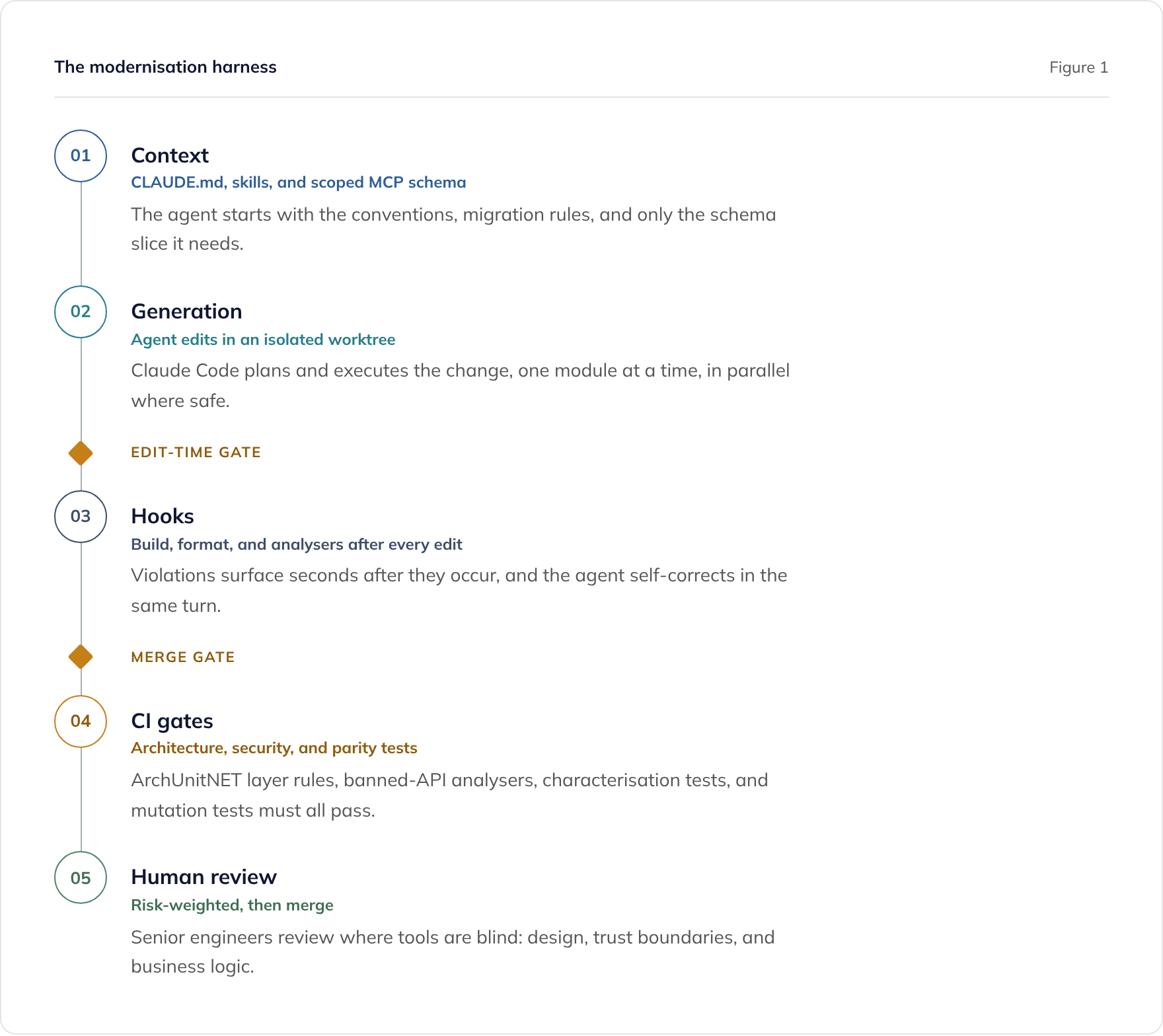
How a change flows through the modernisation harness
Every AI-generated change passes the same deterministic gates before a senior engineer reviews it. The gates run automatically, so a change that breaks a rule is caught whatever the prompt asked for.
From assessment to modernised estate
A structured engagement that starts with evidence and ships value incrementally.
Assessment and inventory
We analyse the estate with agent assistance, covering codebase structure, the screen and event-handler inventory for desktop applications, the stored procedure catalogue and dependency map, the integration surface, and test coverage. A senior architect turns the analysis into a sequenced plan with realistic costs. If modernisation is the wrong answer for your estate, the assessment will say so.
Environment and guardrails
We configure the Claude Code environment before the first migration prompt. That includes context files, pre-approved commands, hooks that run builds and tests after every edit, architecture rules, security analysers, and cost metering. The harness is committed to your repository, so the whole team shares it. If your engineers are new to the tool, our Claude Code for .NET developers guide covers the individual setup.
Modernisation delivery
We deliver module by module in dependency order. Characterisation tests pin behaviour, agents handle the mechanical translation and generation in parallel worktrees, and every change passes deterministic gates and human review. Value ships incrementally rather than all at the end.
Handover or ongoing support
Your team takes over a documented environment they have worked in throughout, or our managed support service runs the modernised estate with the same AI-augmented tooling.
Go deeper
Legacy Application Modernisation
The full modernisation service this page specialises: assessment, re-platforming, and strangler fig migration.
Claude Code Development
Our Claude Code delivery and consultancy service: environment setup, skills, hooks, and governance.
.NET Development
New builds and ongoing C# and .NET engineering from the same team.
Data Migration
Automated nightly migration with anonymised data, for the platform move that often follows.
.NET Modernisation Playbook
The four-pillar enterprise playbook behind this service, free to read.
WinForms to the Web
The desktop-to-web decision framework and delivery workflow in full.
Seen enough? Let's talk through your requirements.
Book a free consultationFrequently asked questions
What is AI-assisted .NET modernisation?
It means using agentic coding tools to speed up the mechanical work of modernising legacy .NET estates, and in our case that is mainly Anthropic's Claude Code. The work includes framework migration, desktop-to-web rebuilds, and database logic modernisation. Agents handle inventory, translation, test generation, and scaffolding under enforced guardrails, while senior engineers make the architectural decisions and review every change.
How much of the work can AI do?
In our delivery, over 90% of the mechanical translation work is AI-authored, and 100% of it is reviewed by senior engineers. The balance is architectural decisions, ambiguous business logic, and edge cases that need human judgement. We publish the production numbers quarterly in our AI Velocity Report, so you can check the claim for yourself.
Can you modernise a WinForms application to the web?
Yes, as a rebuild that salvages what it can rather than a conversion, because no tool can translate a desktop interaction model into a web one. Agents extract the business rules buried in code-behind, characterisation tests pin current behaviour, and the new ASP.NET Core front end is built against enforced architecture rules. Our WinForms to web guide covers the approach in detail.
What happens to business logic in our stored procedures?
We classify before we move anything. Business rules in procedural T-SQL migrate to a tested C# service layer, and set-based bulk operations stay in the database where they perform best. Dead procedures are identified and retired, and every translated rule is proven equivalent by parity tests before cutover. The workflow is documented in our stored procedure modernisation guide.
How do you stop AI writing insecure or badly structured code?
We rely on deterministic controls rather than on prompts alone. ArchUnitNET tests fail the build when a dependency crosses a forbidden layer, and banned-API analysers turn string-concatenated SQL and unencoded output into compile errors. Hooks feed violations back to the agent at edit time, and CI security gates and risk-weighted human review follow. A prompt shapes the first draft, and these checks decide whether it can merge.
How do you keep AI token costs under control?
We treat inference like cloud spend. A written model-tier policy in configuration reserves the top tier for architecture and hard debugging, uses the workhorse tier as the default, and sends mechanical volume to the small tier. Prompt caching is designed into the workflow, context is scoped so agents never carry a whole database schema, and each workstream is metered from week one.
See how AI is changing how we build software
Our quarterly AI Velocity Report tracks real delivery metrics from live projects: how much of our code is AI-authored, how delivery timelines compare to baseline, and which tools are making a measurable difference. No marketing spin, just honest data from a team that builds software every day.
Read the latest AI Velocity ReportReady to size your modernisation?
Start with a free 30-minute consultation about your estate. If it makes sense to go further, our assessment inventories the estate with agent-assisted analysis, and a senior architect turns it into a sequenced plan with realistic costs. If modernisation is the wrong answer, we will tell you.
Book a free consultationor call 01202 006729