
Pricing AI in the Pipeline: Claude Tokens, GitHub Minutes and Copilot Credits
AI in a continuous integration (CI) pipeline is billed on up to four meters: GitHub Actions minutes, Copilot AI Credits, Claude tokens, and Advanced Security licences. In our experience, the bill grows faster than adoption, because more changes, more checks, and more runs multiply together.
- Budget for pipeline minutes and test servers, not only tokens.
- Which meters you pay depends on where each AI step runs.
- Tier the checks, so the expensive ones run once per change.
If you need to show whether your AI tooling spend is changing delivery, our AI Delivery Assessment benchmarks your team against measured delivery data.
Why has AI in the pipeline become a cost question?
Since 1 June 2026, GitHub has billed Copilot by usage, and Copilot code review now uses GitHub Actions minutes on private repositories as well. Claude in the pipeline has always been billed by usage. The Claude Code GitHub Action pays for the runner it uses and for the Claude tokens it consumes.
For an engineering leader, that changes the budget conversation. A seat licence was a fixed line in the budget, while usage-based billing moves with the number of pull requests (PRs), the size of each change, and how often a review runs.
We are a Claude-centred consultancy and a GitHub Technology Partner. We are also a Microsoft Solutions Partner with designations in Digital and App Innovation (Azure) and Infrastructure (Azure), plus the DevOps with GitHub on Azure specialisation. This guide sets out what each option bills, so you can compare them on your own numbers. All prices are as GitHub and Anthropic published them on 24 November 2026, in US dollars.
Why does pipeline cost grow faster than AI adoption?
In our experience, cost becomes a major factor as AI adoption matures, and tokens are only part of it. Pipeline minutes and the servers that tests run against grow too. More changes go through the pipeline, each change carries more checks, and each check runs more often.
Those drivers multiply rather than add. A team that doubles its changes, its checks per run, and its runs per change pays roughly eight times as much for the pipeline, with the same number of engineers. On a budget report, that looks close to exponential.
More changes go through the pipeline
We deliver 40 to 50% faster with AI, and more delivered change means more pull requests. Every PR runs the pipeline, so pipeline volume rises with output, not with headcount. A seat-based view of AI cost misses this, because the seats stay the same while the work through CI rises.
Each change carries more checks
A mature AI harness adds signals, because the checks are how a team earns enough trust in AI-written code to merge it. In one change we measured end to end, twelve layers checked the work. They included about 2,400 unit tests, which ran twice, and around 160 end-to-end tests.
Each of those checks needs compute. Some run on Actions runners, some against databases and test environments that have to exist while they run, and some are model calls in their own right, such as review subagents.
Each check runs more often
An agent works by running the checks, reading the result, and trying again. In the same change, Claude ran the database integration tests 18 times and the end-to-end browser tests 21 times. Running tests took more of its time than writing code.
The same loop applies in CI. If an agent pushes after each fix, and every push to an open PR triggers the full pipeline and an AI review, each extra iteration repeats all of it.
Longer sessions cost more per step
Token cost per step rises as an agent session grows, because the model rereads the conversation so far on each step. In the change we measured, the longest build accounted for over half of everything Claude reread. The AI usage for that change, two linked user stories, came to about $71 at application programming interface (API) list prices. That is small against the people’s time, but it recurs with every change you run.
What this means for your budget
Plan the pipeline budget alongside the token budget from the start of adoption, not after the first large invoice. The controls later in this guide matter more as adoption matures, because each one cuts a factor that the others multiply.
Which meters does each option use?
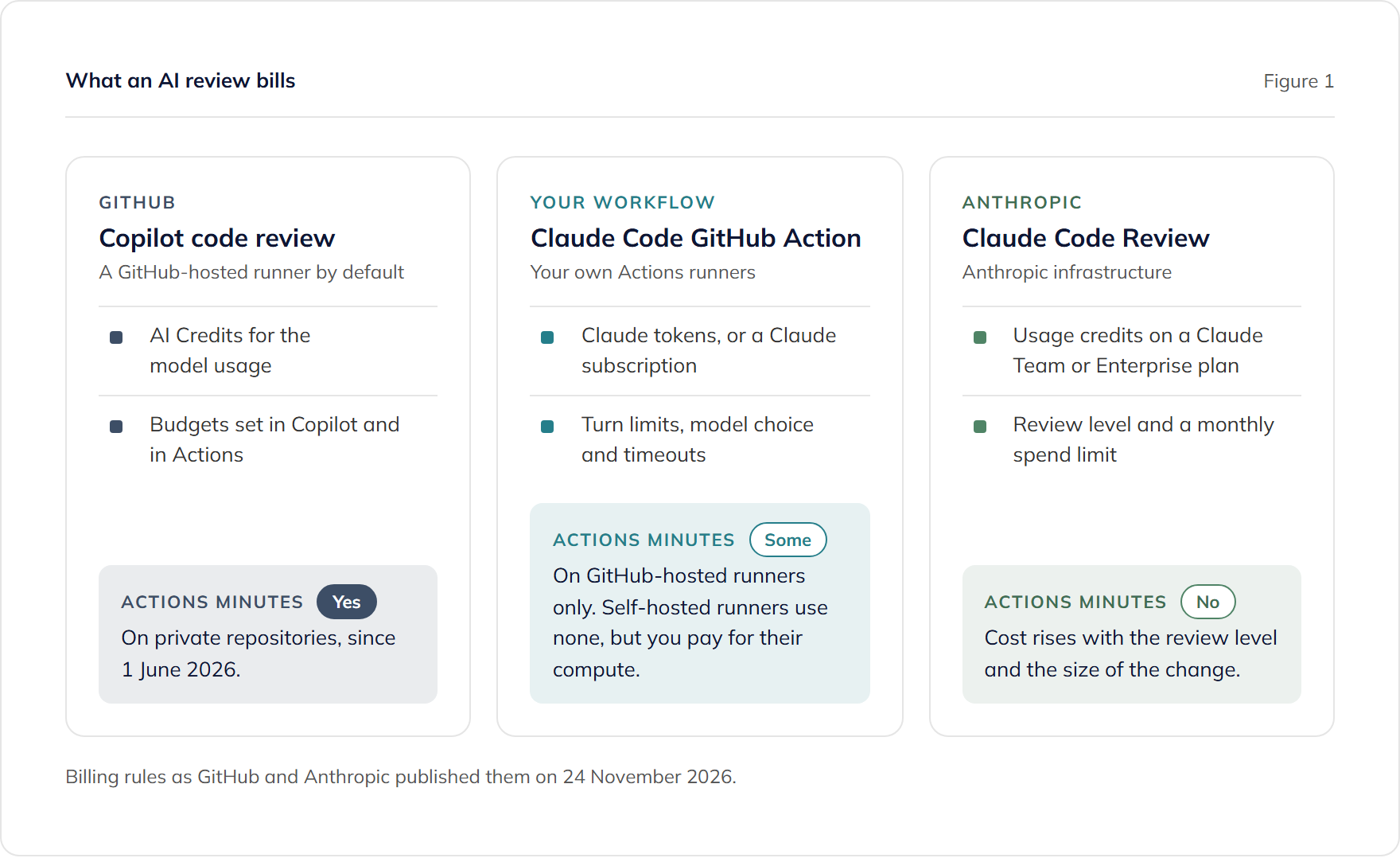
The meters you pay depend on where the AI step runs. The table covers the five AI and security steps teams most often add to a GitHub pipeline.
| Option | Where it runs | What it bills | Main controls |
|---|---|---|---|
| Copilot code review | A GitHub-hosted runner by default; self-hosted and larger runners are supported | AI Credits, plus Actions minutes on private repositories | Copilot budgets, Actions budgets |
| Copilot cloud agent | A GitHub Actions environment or a GitHub cloud sandbox | AI Credits, plus compute from your GitHub account’s allowance | Copilot budgets; Actions sessions stop at 59 minutes |
| Claude Code GitHub Action | Your own Actions runners, GitHub-hosted or self-hosted | Claude tokens, plus Actions minutes on GitHub-hosted runners | Turn limits, model choice, workflow timeouts, concurrency |
| Claude Code Review | Anthropic’s infrastructure | Usage credits on a Claude Team or Enterprise plan | Review level, when reviews run, a monthly spend limit |
| CodeQL code scanning | Your Actions runners, GitHub-hosted or self-hosted | A Code Security licence per active committer, plus Actions minutes | Runner choice and scan schedule |
The Claude Code GitHub Action is a workflow step you configure yourself. Claude Code Review is a managed service that an owner of your Claude organisation turns on, with no workflow file to maintain. The two are often confused because both use the Claude GitHub App.
What does each meter cost today?
Each meter has its own unit and its own allowance. The sections below give the published rates and what each allowance covers.
GitHub Actions minutes
GitHub bills hosted runners by the minute, at a rate set by operating system and size:
| Runner | Price per minute |
|---|---|
| Linux, 2 cores | $0.006 |
| Windows, 2 cores | $0.010 |
| macOS, 3 or 4 cores | $0.062 |
Each plan includes a monthly allowance expressed in dollars, not minutes: $18 on Team and $300 on Enterprise Cloud. Standard GitHub-hosted runners are free for public repositories. GitHub’s billing documentation lists self-hosted runners as free, so the cost of a self-hosted runner is the compute you pay for elsewhere, such as an Azure virtual machine.
GitHub Copilot AI Credits
Copilot features that call a model now consume GitHub AI Credits, and one credit is worth $0.01. Credits are charged for tokens at each model’s published rate. These features consume them:
- Copilot Chat and the Copilot command-line interface (CLI)
- Copilot cloud agent and third-party coding agents
- Copilot Spaces and Spark
- Copilot code review
Copilot Business includes 1,900 credits per user each month, and Copilot Enterprise includes 3,900. Credits are pooled across the billing entity, so 100 Business users share 190,000 credits. Unused credits do not carry over.
On Business and Enterprise plans, additional usage beyond the pool is enabled by default. An administrator has to turn off the ‘AI credits paid usage’ policy, or set budgets, to stop spending beyond the included credits.
Claude tokens
The Claude Code GitHub Action bills tokens at Anthropic’s API rates when it authenticates with an API key. Prices are per million tokens:
| Model | Input | Output | Cache read |
|---|---|---|---|
| Claude Opus 5.5 | $4 | $20 | $0.20 |
| Claude Sonnet 5.5 | $2 | $10 | $0.10 |
| Claude Haiku 5.5 (prompts up to 100,000 tokens) | $0.10 | $0.50 | $0.01 |
Claude Haiku 5.5 costs more for prompts over 100,000 tokens ($0.50 input and $2.50 output). A cache read is a prompt prefix served from Anthropic’s prompt cache, which matters in CI because the same repository context is sent on every run.
The action can also route the same work through Amazon Bedrock, Google Cloud, or Microsoft Foundry. Anthropic bills Claude in Foundry at its standard API rates through the Azure Marketplace, so a Microsoft-stack team can keep the spend on its Azure invoice.
Claude Code Review usage credits
Claude Code Review has no flat price per review. It is billed on token usage through usage credits on a Claude Team or Enterprise plan, separately from the plan’s included usage. The cost of a review rises with the review level (Quick, Standard or Deep), the size of the change, and the number of candidate issues it has to verify.
Because the review runs on Anthropic’s infrastructure, it uses no GitHub Actions minutes. Anthropic’s own advice is to run a small pilot with a spend limit and read the average cost per review for each repository before rolling it out.
GitHub Advanced Security licences
GitHub sells Secret Protection at $19 and Code Security at $30, each per active committer per month. Code Security includes CodeQL code scanning, Copilot Autofix, the dependency review action, and security campaigns.
A committer is active if they pushed a commit to a covered repository in the last 90 days. Each person uses one licence across the organisation, and GitHub App bots are ignored. CodeQL scans run as Actions jobs, so on GitHub-hosted runners they use Actions minutes as well.
Copilot Autofix comes in two forms. GitHub’s documentation says agentic autofix consumes Code Security AI credits, while classic Copilot Autofix does not.
How do you work out the cost of one pull request?
The cost of AI on one PR is the number of runs, multiplied by the cost of each run. A run costs its runner minutes plus its model usage, and either can be zero depending on where it runs.
- Runs per PR depend on the trigger. A review that runs after every push costs the number of pushes times the cost of one review. A review that runs once when the PR opens costs one review.
- Runner cost is minutes times the runner rate. A 10-minute job on a Linux 2-core runner costs $0.06; the same job on macOS costs $0.62.
- Model cost is tokens times the model rate. On Claude Sonnet 5.5, 100,000 input tokens cost $0.20 and 10,000 output tokens cost $0.10.
These are illustrations of the arithmetic, not typical figures. Token use per review varies with the size of the change, the size of the repository context, and how many turns the agent takes.
Where to find your real numbers
Measure a month of your own usage before comparing options. Each vendor reports it in a different place:
- GitHub Actions minutes and AI Credits: the billing usage report in your account or organisation settings.
- Claude API tokens: the usage pages of the Claude Console, or Claude Code’s analytics and monitoring.
- Claude Code Review: the Code Review analytics page, which shows estimated cost per repository and per PR.
Where do Claude and GitHub compete, and where do they work together?
In a GitHub pipeline, Claude and GitHub overlap on the AI steps and complement each other on everything else. The overlaps are where you risk paying twice.
They compete in three places:
- Pull request review: Copilot code review, Claude Code Review, and a review step in the Claude Code GitHub Action all do the same job.
- Agents that turn issues into PRs: the Copilot cloud agent and an
@claudemention in an issue both produce a branch and a PR. - Fixing security alerts: Copilot Autofix and Claude can both propose fixes for code scanning alerts.
They work together everywhere else. Actions is where the Claude Code GitHub Action runs. CodeQL and secret scanning check Claude’s changes in the same way as an engineer’s. Dependabot raises dependency updates, and Claude can fix the breaking changes they cause.
Copilot also offers Claude models, so for many teams the choice is between Claude through Copilot and Claude directly. Our Claude Code vs GitHub Copilot guide explains why the harness around the model, more than the model, separates the two products.
How do you keep each meter under control?
The controls are much the same whichever tool you choose. Running fewer and smaller AI steps saves on every meter at once, while a cheaper model saves only on tokens.
Run the deterministic checks first
Make the AI step depend on the build, the tests, and static analysis passing. A model reviewing a change that does not compile spends tokens on problems a compiler would have found for a fraction of a cent. Our harness engineering guide explains why deterministic checks belong before inferential ones.
Decide how often a review runs
Running a review after every push multiplies its cost by the number of pushes. Claude Code Review lets you choose per repository between once after the PR opens, after every push, or only on request. In your own workflows, the trigger events set the same thing.
Tier the checks by stage
Not every check needs to run on every push. Run the fast checks, such as the build, unit tests, and linting, on each push. Keep the slow and expensive ones, such as end-to-end suites, load tests, and the AI review, for when a PR is marked ready or is about to merge.
Tiering cuts the runs-per-change factor for the most expensive checks, which is where the multiplication hurts most. It also cuts server cost, because the test environments and databases that end-to-end tests need only have to run when those tests do.
Cap each run
Anthropic’s documentation lists the controls for the Claude Code GitHub Action:
- Set
--max-turnsinclaude_argsto limit iterations. - Set workflow-level timeouts to stop runaway jobs.
- Use GitHub’s concurrency controls to limit parallel runs.
- Keep
CLAUDE.mdconcise, because Claude reads it on every run.
Our Claude Code configuration guide for .NET includes a starter Actions workflow with these settings in place.
Choose the model for each job
Set --model per workflow rather than using one model everywhere. Claude Haiku 5.5 costs one twentieth of Claude Sonnet 5.5 for input tokens, which suits triage and labelling. Keep the more capable models for reviews and changes where a missed defect costs more than the tokens. Our token cost management guide covers model-tier policy and prompt caching across a whole programme.
Move long jobs to self-hosted runners
Self-hosted runners use no Actions minutes, and both CodeQL and Copilot code review support them. They suit long or frequent jobs, where you can size and pay for the compute in Azure. GitHub announced a per-minute platform charge for self-hosted runners in December 2025 and has not applied it. Check the billing documentation before planning around free self-hosted minutes.
Set budgets before usage starts
Copilot Business and Enterprise allow additional usage by default, so set budgets at user, cost centre, or organisation level first. Set a monthly spend limit for Claude Code Review and for your Claude Console workspace. Add an Actions budget, so that a busy month raises an alert rather than a surprise invoice.
Pay for one AI reviewer per repository
Pick one AI reviewer for each repository and turn the others off there. Running Copilot code review and a Claude review on the same PR doubles the model cost and the number of comments engineers have to read.
Should you compare cost per minute, per token, or per change?
Compare cost per reviewed change. A cheaper review that misses a defect, or needs a second run, can cost more by the time the change is merged.
Per-minute and per-token rates are inputs, not answers. A model that costs more per token but finishes in fewer turns can cost less per change. The same applies to agents: an agent that completes a whole task changes what each engineer produces, which a per-seat or per-token view does not show. We publish our own delivery measures each quarter in the AI Velocity Report.
How can Talk Think Do help?
We build delivery pipelines on GitHub Actions and Azure, and Claude models and Claude Code are our primary development stack. Static code analysis with GitHub Advanced Security, extended with our own in-house rules, runs automatically on every pull request.
- AI Delivery Assessment: for engineering leaders who need to show whether AI tooling is changing delivery. It benchmarks your team against our published delivery data and ends with a prioritised 90-day roadmap.
- GitHub Actions CI/CD and Advanced Security: for teams who want reusable workflows, code scanning, and AI steps set up with budgets and gates from the start.
- Claude Code development: for organisations commissioning a build delivered with Claude Code under senior engineer review.
See our pricing page for current engagement ranges, or book a consultation to talk through your pipeline.
Frequently asked questions
Can the Claude Code GitHub Action use a Claude subscription instead of an API key?
Can we pay for Claude in our pipeline through Azure?
Are public repositories cheaper to run AI on?
Do Copilot code completions use AI Credits?
Does an AI agent count as an active committer for GitHub Advanced Security?
Related guides
Claude Code vs GitHub Copilot for .NET Teams: A UK CTO's Guide
Claude Code vs GitHub Copilot for .NET teams: autocomplete versus agentic delivery, what Copilot running Claude models changes, and how UK CTOs decide.
AI-Augmented vs AI-Assisted Development: The Difference
AI-assisted development uses AI as an editor helper. AI-augmented development integrates AI across the lifecycle, with measurable delivery gains. The distinction in 2026.
Token Cost Management for AI-Assisted Modernisation Programmes
Token cost management for AI-assisted development: model-tier policy, prompt caching, context engineering, and practical multi-model guidance for programme budgets.