
React Native Development
Cross-platform mobile apps, one codebase
We build cross-platform mobile apps in React Native, one codebase for iOS and Android, backed by robust cloud back ends and a clear view of when native is the better call.
What React Native development with Talk Think Do means
React Native development is the building of mobile apps from a single codebase that runs natively on both iOS and Android. It is the right choice when you want to reach both platforms quickly and maintain one team, not two. This page is for product owners and technical buyers weighing up cross-platform mobile.
It is the framework we reach for most within our broader mobile app development service. We will always tell you when fully native is the better fit.
The mobile problems we are brought in to solve
Cross-platform is a means, not an end. These are the problems that bring teams to React Native in the first place.
Two codebases, double the cost
Maintaining separate native iOS and Android builds doubles the effort, splits the team, and slows every release. Features land on one platform weeks before the other.
Cross-platform that feels cheap
Generic cross-platform apps ignore platform conventions, feel sluggish, and frustrate users. The saving is wiped out by poor reviews and low adoption.
A weak or missing back end
An app is only as good as the systems behind it. Flaky sync, slow APIs, and no offline support turn a promising app into one people stop opening.
Stuck in app-store release cycles
Every small fix waits on a full store review, so urgent changes take days. Without over-the-air updates and proper CI/CD, shipping is slow and painful.
React Native development capabilities
One codebase across iOS and Android, with native depth, a secure cloud back end, and a clean release pipeline.
One codebase, iOS and Android
Native depth where it matters
Robust cloud back ends
Offline-first and resilient
App Store and enterprise delivery
Migrations and rescues
AI-augmented React Native engineering
Every engineer uses AI-augmented development as part of our standard process. That makes delivery 40 to 50% faster than a traditional team, with 91.6% of our code now AI-authored, 100% senior-engineer reviewed. The figures are measured on live projects and published openly.
Architecture, security, and the native-versus-cross-platform call stay with experienced engineers. Read how we measure delivery in our AI Velocity Report.
When React Native is the right call
An honest comparison of cross-platform and native approaches, so the choice fits your app rather than our preference.
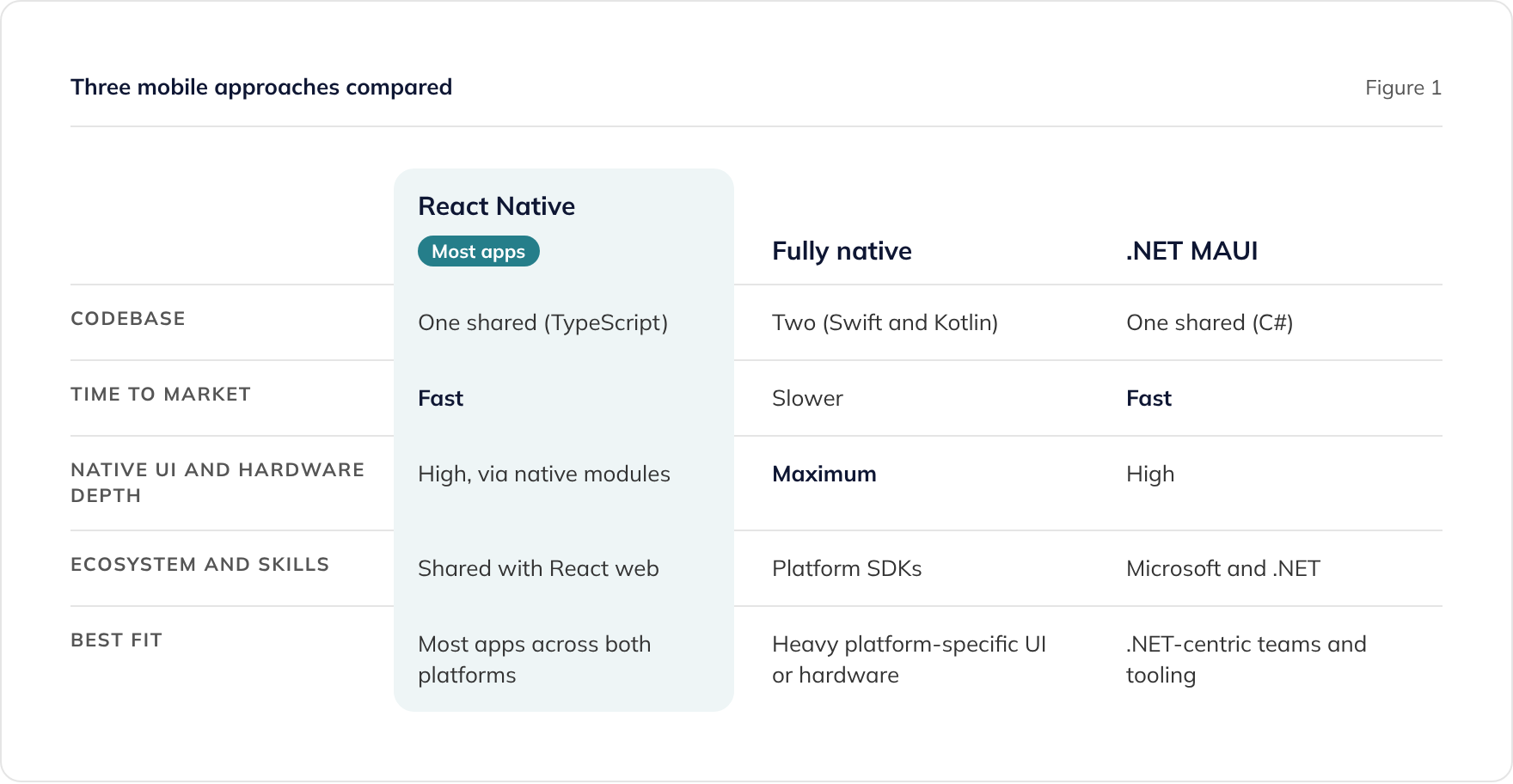
Our React Native delivery process
A structured process that designs the app and its back end to fit from day one.
Discovery and platform decision
We map the app's users, features, and distribution model, then give you an honest recommendation on React Native versus native, with the trade-offs made explicit and costed.
Architecture and back end
We design the React Native app and the cloud back end together, including the API layer, authentication, and offline strategy, so the two are built to fit rather than bolted together later.
Build in React Native
We build with React Native and Expo in agile sprints, using AI-augmented engineering and TypeScript, and drop into native modules where the platform requires it. You see working builds on real devices throughout.
Test on real devices
We test across real iOS and Android devices for performance, accessibility, and security, and scan every build for open-source licence issues before release.
Release and support
We automate App Store and Google Play submissions through mobile CI/CD, ship over-the-air updates, and provide ongoing support as the app evolves.
A React Native member app for a luxury gym chain
For Third Space, London's luxury health club collection, we built the member app in React Native as part of the Atlas platform: a complete rebuild of their digital ecosystem on cloud-native Azure. The platform runs at 99.99% uptime and serves more than 40,000 monthly active members.
One codebase
Platform uptime
Monthly active users
The member app sits alongside instructor tools and an operations portal on the same Azure platform. Read the Third Space case study.
"We've gone from hours of admin to instant updates. It's given us endless time back and a seamless experience for our instructors."
Amanda Chambers
Group Exercise Studio Operations Manager, Third Space
React Native specialists who own the back end too. We build the app and the secure Azure systems behind it, and give you an honest call on when native is the better fit, with full source code ownership.
About Talk Think Do
Talk Think Do is a UK-based software development company founded by Matt Hammond and headquartered in Bournemouth, Dorset. We are a Microsoft Solutions Partner with designations in Azure Infrastructure, Digital and App Innovation, and DevOps and GitHub.
We build cross-platform mobile apps in React Native and the secure Azure back ends behind them, so the app and its systems are designed together. We hold ISO 27001 certification, Cyber Essentials Plus certification, and approved Government Commercial Agency (GCA) supplier status on the G-Cloud 15 and Digital Outcomes and Specialists 7 (DOS 7) frameworks.
Our clients include:
- Third Space
- Avios
- Department for Education
- CalMac Ferries
- Hachette Learning
AI-augmented development is central to how we work. Every engineer uses AI tools such as Cursor, Claude Code, and GitHub Copilot daily, and we run a quarterly evaluation cycle to keep improving. The result is mobile software delivered faster, without compromising architecture, security, or code quality.
Seen enough? Let's talk through your requirements.
Book a free consultationReact Native development: frequently asked questions
What is React Native development?
React Native development is the building of mobile apps with React Native, a framework that produces native iOS and Android apps from a single shared codebase. It suits apps that need to reach both platforms quickly without maintaining two separate native teams. It is the cross-platform framework we use most often within our mobile app development service.
React Native or fully native: which is right for us?
React Native suits most apps, especially when you want one codebase across iOS and Android and can share skills with a React web team. Fully native iOS and Android is the better call when the app is dominated by platform-specific UI or deep hardware integration. We give you a clear recommendation during discovery rather than defaulting to one answer.
Can React Native handle enterprise and internal apps?
Yes. We build consumer apps for the public app stores and internal staff apps distributed through mobile device management (MDM) such as Microsoft Intune. React Native supports offline-first behaviour, secure storage, and kiosk-style use where needed.
How does a React Native app connect to our systems?
Through a secure cloud back end. We typically use a backend-for-frontend (BFF) on Azure to shape data for the app, with REST or GraphQL APIs and OAuth 2.0 authentication. See our mobile app backends service for detail.
Do you handle App Store and Google Play submission?
Yes. We build with Expo and automate builds and submissions to both the App Store and Google Play using Expo Application Services (EAS) Build and CI/CD pipelines. We also manage over-the-air updates, so you can ship many fixes without a full store release each time.
Can you take over an existing React Native app?
Yes. We take on existing React Native codebases that have become hard to maintain or scale, assess the state of the code, and stabilise it onto a well-tested, maintainable footing. We can also migrate ageing native or Xamarin apps across to React Native.
How much does a React Native app cost?
Cross-platform apps typically sit within our published band of £25,000 to £100,000+, with cost depending on features, integrations, and back-end complexity. Sharing one codebase across iOS and Android usually costs less than two native builds. We provide a detailed estimate after a short discovery engagement (from £4,000).
Go deeper on mobile
Mobile API Best Practices
Designing mobile back ends that scale: protocol choice, auth, offline sync, and push.
Backend for Frontend (BFF) Pattern
Why a BFF is usually the right way to feed a mobile app, and how it compares to a single API.
Harness Engineering for Coding Agents
How we steer AI coding agents on React and TypeScript stacks for safe, fast delivery.
What is AI-Augmented Development?
The meaning, practice, and production evidence behind our delivery model.
REST vs GraphQL vs gRPC
Choosing the right API style for the data your mobile app consumes.
Third Space: Building Atlas
The full case study behind the digital ecosystem, including the member app, we built.
See how AI is changing how we build software
Our quarterly AI Velocity Report tracks real delivery metrics from live projects: how much of our code is AI-authored, how delivery timelines compare to baseline, and which tools are making a measurable difference. No marketing spin, just honest data from a team that builds software every day.
Read the latest AI Velocity ReportExplore our other services
Mobile App Development
Our parent service: native and cross-platform iOS and Android apps for consumer and enterprise.
Mobile App Backends
The secure, scalable Azure back ends that power a React Native app.
Mobile App CI/CD
Expo and EAS Build pipelines with automated App Store and Google Play submission.
React Development
Building for the web instead? Fast, maintainable React web applications.
Custom Software Development
Bespoke software on Azure with full code ownership and AI-augmented delivery.
Claude Code Development
AI-accelerated mobile and full-stack delivery using Claude Code, with full IP ownership.
Ready to build a cross-platform app?
Tell us about your app and who it is for. We will recommend React Native or native honestly, then give you a clear plan and a cost estimate, with no obligation.
Book a free consultationor call 01202 006729