
AI Assessment with Learnosity Build
Most of the AI you want is already in the product. The hard part is everything around it.
Learnosity Build now ships AI-assisted authoring, Feedback Aide for agentic AI essay scoring, and Item Bank Health Check for item quality and accessibility remediation. You do not need to build any of that.
What you do need is the layer that makes it usable and defensible: integration into your product, human moderation of AI output, and a clear answer on where learner data goes.
We are a Learnosity Services Partner and we build that layer on Azure.
Why assessment teams are looking at AI now
These are the four pressures we hear most often from publishers, tutoring organisations, and awarding bodies.
Marking written answers does not scale
Essay and long-form questions give you the richest evidence of learning, and the highest marking cost. Teams either limit written assessment to keep marking manageable, or they accept slow turnaround. Neither choice is good for learners, and neither is a technology problem you should solve from scratch.
Authoring is the bottleneck, not delivery
Curriculum teams can usually deliver assessments faster than they can write them. Item creation, review, tagging, and accessibility checks all take specialist time. A platform that delivers beautifully but starves for content will not hit its launch date.
Legacy item banks carry years of drift
Item banks built over a decade accumulate inconsistent answer keys, missing alt text, untranscribed audio, and metadata that no longer matches the curriculum. Auditing tens of thousands of items by hand is not realistic, so the problem compounds quietly.
AI in assessment has to be defensible
Assessment decisions affect learners, so an AI score you cannot explain, moderate, or audit is a liability. Any AI in the marking path needs human oversight, a record of what happened, and a clear answer on where learner data was processed.
What we have delivered, and what is new
Learnosity Build's AI capabilities are recent additions to the product. We have not yet shipped a client platform that uses them in production, and we would rather tell you that than imply a track record we do not have.
What we have done is the work that surrounds them. We have built and run assessment platforms on Learnosity at national scale, and we have delivered production AI systems on Azure for other clients.
That combination is the relevant experience. Enabling an AI feature is rarely the risk on these projects. The risk sits in integration, in the human process around AI output, and in the data protection questions a school or awarding body will ask you.
If you want a partner who has already shipped Feedback Aide ten times, we are not that partner yet. If you want one who knows how to put a new capability into a live platform serving hundreds of thousands of learners without breaking it, that is exactly what we do.
See our Learnosity Build integration service for the wider delivery picture.
What we bring to an AI assessment project
-
Learnosity delivery at national scale
Boost Insights for Hachette Learning serves 4,000+ schools and 845,000+ pupils, processing over 3 million assessments a year on Learnosity and Azure.
-
Item bank experience that matters here
Our assessment authoring system for Explore Learning delivered more than 60,000 questions, so we understand what a real item bank looks like before AI touches it.
-
Custom logic on top of Learnosity
For Explore Learning we built the adaptive logic engine inside Compass, their learning platform, and integrated it with Learnosity for assessment delivery. That is the same split this page describes, and Compass at Home won a UK Business Tech Transformation Award.
-
Production AI on Azure
We have delivered AI systems in production, including an Azure OpenAI and Azure AI Search platform for FundingImpact.AI.
-
Governance built in, not added later
Data protection by design, documented data flows, and an audit trail of automated decisions, because assessment decisions get challenged.
Native AI capability, production-ready
Learnosity Build provides the AI. We make it fit your product, your editorial process, and your compliance obligations.
AI-assisted authoring integrated into your workflow
AI essay scoring with human oversight
Item bank remediation at scale
Custom AI where the native features stop
Data protection and AI governance
Accessibility as a first-class outcome
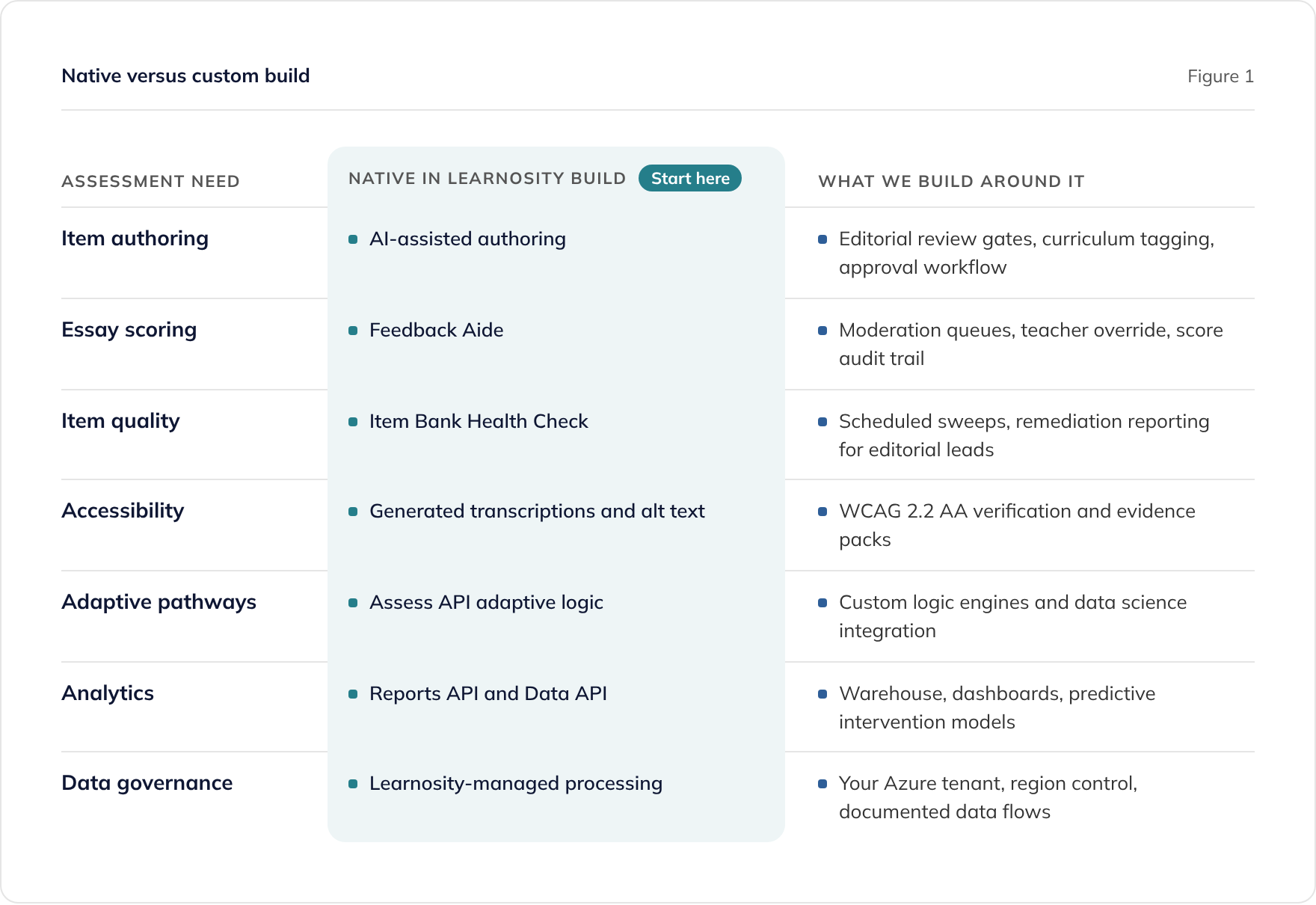
What comes native, and what we build
Start with the native capability wherever it fits. Custom AI is for the requirements that sit outside the product.
From discovery to AI in production
A pilot on your real content comes before any commitment to a rollout.
Assessment AI discovery
We map your assessment lifecycle against what Learnosity Build now does natively. The output separates three things clearly: what you get by enabling a native feature, what needs integration work, and what needs custom AI.
You leave with a costed shortlist rather than a general AI strategy document.
Pilot on a real item bank
We pilot the chosen capability against a representative slice of your real content and your real marking standards. For scoring, that means comparing AI output with your markers on a sample large enough to judge.
The pilot produces evidence: agreement rates, failure patterns, and the moderation rules the live system will need.
Build the oversight layer
AI features rarely fail on model quality alone. They fail because nobody designed the human process around them. We build the moderation queues, override paths, sampling, reporting, and audit trail that make AI output safe to act on.
Roll out and monitor
We release progressively, monitor agreement and exception rates in production, and calibrate the thresholds as real usage arrives. Ongoing managed application support keeps the assessment window covered.
Seen enough? Let's talk through your requirements.
Book a free consultationFrequently asked questions
Can we use AI to mark essays and written answers in our assessment platform?
Yes. Feedback Aide is an embeddable agentic AI grading engine inside Learnosity Build, so AI essay scoring and written-response feedback are a product capability rather than something you build. Our work is the layer around it: embedding it in your product, and designing the moderation, override, and audit process that makes an AI score defensible.
Have you already delivered a project using Learnosity Build's AI features?
Not yet, and we would rather say so than imply otherwise. These capabilities are new to the product, and no client platform we have shipped uses them in production today.
What we do bring is directly relevant:
- Learnosity Services Partner status, and platforms on Learnosity serving 845,000+ pupils and 3 million+ assessments a year
- An assessment authoring system for Explore Learning that delivered 60,000+ questions
- Production AI delivery on Azure, including an Azure OpenAI and Azure AI Search platform for FundingImpact.AI
The integration and governance work is the hard part, and that is work we have done repeatedly.
Do we need Learnosity Build to get AI assessment features?
No, but it changes the economics considerably. Building comparable AI authoring, scoring, and item analysis yourself means owning model selection, evaluation, and drift management indefinitely. Because these capabilities are native to Learnosity Build, you get them behind a stable API and Learnosity carries the model work.
We recommend custom AI only where your requirement falls outside the product, and we will tell you when it does not.
How do you stop AI marking from being wrong or unfair?
You design for it rather than hope. On our projects that means:
- A calibration pilot comparing AI scores against your own markers before go-live
- Human moderation queues, with teacher override always available
- Ongoing sampling and agreement-rate monitoring in production
- An immutable audit trail recording every automated decision
Assessment carries real consequences for learners, so AI belongs in the marking path only with oversight around it.
Where is our learner data processed when AI scores an assessment?
It depends on which route you take, and it is worth settling early. Native Learnosity Build AI features are processed by Learnosity, so their terms and data handling apply, and we help you get those answers in writing during discovery.
Anything we build with Azure AI services runs in your own Azure tenant, with the region under your control. Either way we document the data flows as part of data protection by design.
Can AI improve the accessibility of an item bank we already have?
Yes, and this is often the fastest return on a legacy bank. Item Bank Health Check generates transcriptions for audio and video questions and contextual alt text for images, alongside flagging inconsistent answer keys.
We run it as a repeatable sweep rather than a one-off, then verify the output against WCAG 2.2 AA so the improvement is evidenced.
What does an AI assessment project cost?
The engineering cost depends on how much sits outside the native features. Enabling and integrating a Learnosity Build capability with proper oversight is a far smaller piece of work than building custom models. A discovery and pilot is typically the sensible first commitment, because it prices the rest accurately.
Licensing for the native AI capabilities is agreed with Learnosity directly. We can help you scope what you need before that conversation. Book a free consultation to work through it.
See how AI is changing how we build software
Our quarterly AI Velocity Report tracks real delivery metrics from live projects: how much of our code is AI-authored, how delivery timelines compare to baseline, and which tools are making a measurable difference. No marketing spin, just honest data from a team that builds software every day.
Read the latest AI Velocity ReportExplore the wider picture
Thinking about AI in your assessment platform?
A short discovery tells you which of these capabilities you actually need, whether:
- You want to cut essay marking turnaround
- Your curriculum team cannot author fast enough
- Your legacy item bank needs accessibility remediation
or call 01202 006729