
AI Agent Development
AI agents that do real work in your business
We design and build AI agents that do real work inside your business, not just answer questions. Agentic systems grounded in your data and processes, built and supervised by an engineering team that ships them safely.
What AI agent development with Talk Think Do means
AI agent development is the building of agentic systems that plan and take actions to complete real tasks, not just chatbots that answer questions. An agent can work through a process, call your APIs, and update your systems within boundaries you set. This page is for organisations ready to move past the chatbot and put agents to work.
We design agents grounded in your data and processes, build them from small focused components, and supervise them in production. It is the agentic end of our wider AI development and implementation work.
The problems agents are brought in to solve
Agents earn their place when they do work people would otherwise do by hand. These are the problems that lead there.
Chatbots that only talk
A pilot answers questions well in a demo, but never does any actual work. It cannot complete a task end to end, so it stays a novelty rather than a tool the business relies on.
Generic AI that ignores your data
Off-the-shelf tools do not know your processes, your systems, or your rules. The output sounds plausible but is not grounded in how your organisation actually operates.
Manual, repetitive work
High-volume tasks that follow clear rules still tie up skilled people: checking eligibility, reconciling records, triaging requests, chasing approvals. The cost is real and recurring.
Fear of unsafe automation
The worry that an agent will act without oversight, take the wrong action, or leak data. Without scoped access, audit, and human checkpoints, that fear is justified.
AI agent development capabilities
Agentic systems that take action, grounded in your data and built to be supervised safely.
Agents that take action
Grounded in your data and processes
Built from focused, composable agents
Safe by design
Built on Azure OpenAI and Claude
Evaluated, not assumed
AI-augmented engineering, agentic systems
We build agents the same disciplined way we build everything else, with AI-augmented development as standard. Across our work, that makes delivery 40 to 50% faster than a traditional team, with 91.6% of our code now AI-authored, 100% senior-engineer reviewed. The figures are measured on live projects and published openly.
Agent architecture, grounding, and safety decisions stay with experienced engineers. Read how we measure delivery in our AI Velocity Report.
The agent execution loop
How a well-designed agent moves from a trigger to a supervised, audited outcome.
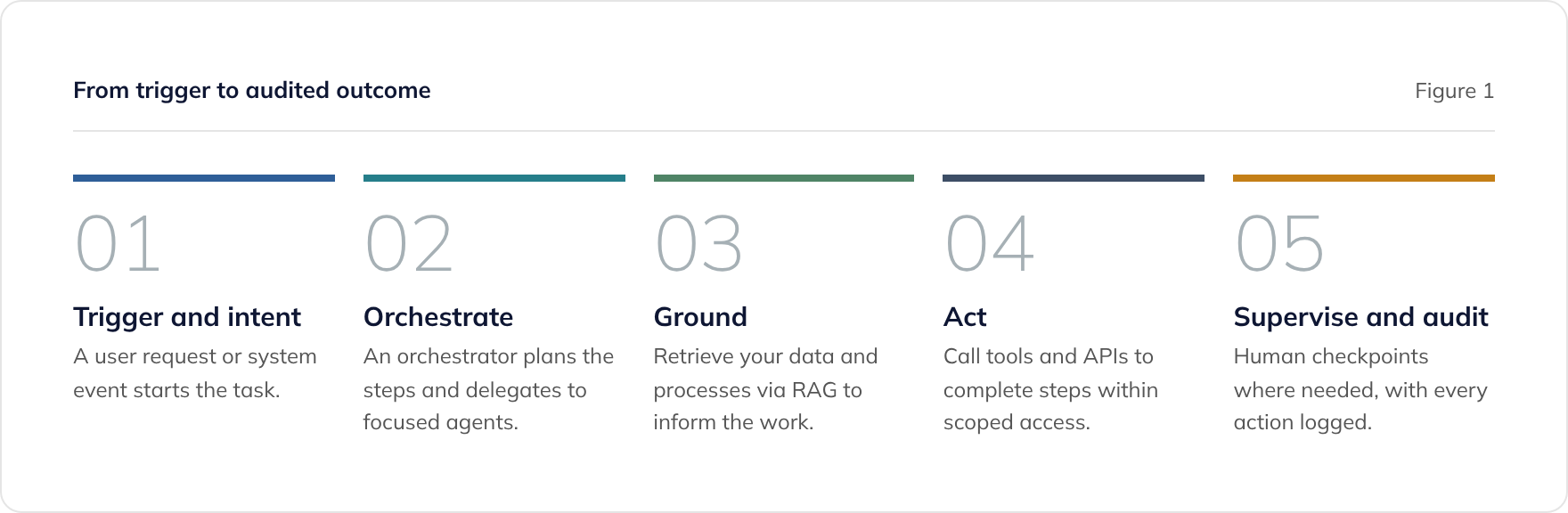
Our AI agent delivery process
From a well-chosen first task to a supervised agent in production.
Identify the task
We find the real work an agent should do and the assets it can build on: your processes, APIs, access controls, and data. You get an honest view of what is a good agentic fit and what is not.
Design the agent system
We design focused, single-responsibility agents and an orchestrator to coordinate them, applying the principles in our writing on object-oriented agent design.
Build and ground
We build the agents, connect them to your tools and APIs, and ground them in your data with RAG. We often deliver this work with Claude Code for speed without losing control.
Guardrails and evaluation
We add scoped access, audit logging, and human checkpoints, then evaluate the agents against real scenarios so behaviour is measured, not assumed, before anything goes live.
Deploy and supervise
We deploy into production with monitoring and ongoing supervision, tuning the agents as they meet real-world cases and your processes evolve.
AI grounded in real data, with real outputs
For FundingImpact.AI, we built a platform on Azure OpenAI and Azure Search that goes beyond a chat interface: it indexes a body of evidence and produces detailed reporting, content, and actionable recommendations. It is a working example of AI grounded in a client's data and processes to do useful work, the same foundation our agentic systems are built on.
Our approach is set out in two articles: agentic design and your hidden assets and object-oriented agent design.
Agentic systems that do real work, designed and supervised by engineers. We carve the gap beyond chatbots: agents grounded in your data and processes, shipped safely with full code ownership.
About Talk Think Do
Talk Think Do is a UK-based software development company founded by Matt Hammond and headquartered in Bournemouth, Dorset. We are a Microsoft Solutions Partner with designations in Azure Infrastructure, Digital and App Innovation, and DevOps and GitHub.
We design and build agentic AI on Azure OpenAI and the Claude API, grounded in client data and supervised by an engineering team. We hold ISO 27001 certification, Cyber Essentials Plus certification, and approved Government Commercial Agency (GCA) supplier status on the G-Cloud 15 and Digital Outcomes and Specialists 7 (DOS 7) frameworks.
Our clients include:
- FundingImpact.AI
- Department for Education
- CalMac Ferries
- Hachette Learning
- Third Space
AI-augmented development is central to how we work. Every engineer uses AI tools such as Cursor, Claude Code, and GitHub Copilot daily, and we run a quarterly evaluation cycle to keep improving. We bring that same discipline to the agents we build for clients.
Seen enough? Let's talk through your requirements.
Book a free consultationAI agent development: frequently asked questions
What is AI agent development?
AI agent development is the building of agentic systems that can plan and take actions to complete tasks, rather than only generating text in response to a prompt. An agent can call APIs, work through multi-step processes, and update systems, all within boundaries you set. Talk Think Do designs and builds AI agents grounded in your data and processes, and supervises them in production.
How is an AI agent different from a chatbot?
A chatbot answers questions. An agent does work. An agent can decide what steps are needed, call tools and APIs, and complete a task end to end, such as checking eligibility, booking a resource, and confirming it. The value is in the action it takes, grounded in your processes, not just the answer it gives.
What makes a good first agent project?
A high-volume, rules-based task that ties up people, where the systems involved already have APIs and the process is documented. Those traits make for a safe, high-return first agent. We help you pick one during discovery, then prove value on it before you scale to more.
Are agentic systems safe to put into production?
They are when they are engineered properly. We build agents with scoped access, audit logging, and human-in-the-loop checkpoints, and we evaluate them against real scenarios before they go live. An engineering team supervises them in production. We are ISO 27001 and Cyber Essentials Plus certified, and those standards apply throughout.
What do we need in place to build AI agents?
Often less than people expect. Documented processes, API-driven systems, access controls, and clear data-handling practices are the assets agents build on, and many organisations already have them. We assess what you have and design around it, as we describe in our article on agentic design and the hidden assets your business may already have.
How do you build AI agents?
We design small, focused agents with an orchestrator, ground them in your data with RAG, and connect them to your tools and APIs. We build on platforms such as Azure OpenAI and the Claude API, and use Claude Code to accelerate delivery. Experienced engineers own every architectural and safety decision.
How much does AI agent development cost?
It depends on the task, the systems an agent must reach, and your safety requirements. We usually start with a focused pilot on one well-chosen task, which keeps initial cost and risk low and proves value before you scale. We give you a clear estimate after a short discovery.
Go deeper on AI agents
Agentic Design and Your Hidden Assets
The five assets most businesses already have that make agent deployment fast and safe.
Object-Oriented Agent Design
Why single-responsibility agents and orchestration beat one monolithic agent.
Harness Engineering for Coding Agents
How we steer agents safely: harnesses, sensors, and deterministic tools.
RAG vs Fine-Tuning vs Prompt Engineering
Choosing the right way to ground an agent in your data, with costs and trade-offs.
What is AI-Augmented Development?
The meaning, practice, and production evidence behind our delivery model.
FundingImpact.AI
The case study behind the Azure OpenAI platform grounded in a client's data.
See how AI is changing how we build software
Our quarterly AI Velocity Report tracks real delivery metrics from live projects: how much of our code is AI-authored, how delivery timelines compare to baseline, and which tools are making a measurable difference. No marketing spin, just honest data from a team that builds software every day.
Read the latest AI Velocity ReportExplore our other services
AI Development & Implementation
Our parent AI service: generative AI, RAG, copilots, and agentic systems on Azure.
Claude Code Development
The agentic coding tool we use to build software, and often the agents themselves, faster.
Custom Generative AI
Azure OpenAI, Copilot customisation, and RAG architectures for enterprise.
AI Integration
Custom MCP servers, RAG pipelines, and hybrid AI and deterministic architectures.
Copilot Studio Rescue
Rescue a stuck Copilot Studio deployment with proper model and data integration.
Azure AI Foundry Development
Model selection, deployment, and evaluation on Azure AI Foundry.
Ready to put an AI agent to work?
Tell us about the task you want an agent to handle. We will assess the fit, design a safe first pilot, and give you a clear plan and cost estimate, with no obligation.
Book a free consultationor call 01202 006729