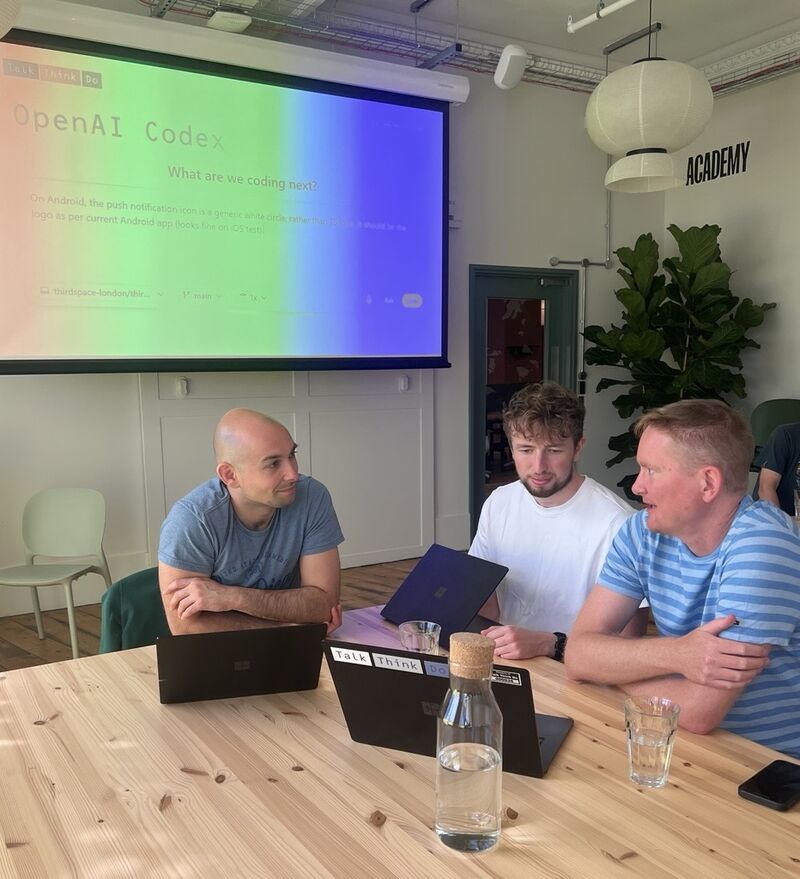
About Matt Hammond
Matt Hammond founded Talk Think Do in 2014 with one goal: to build the kind of software partner he always wished existed. With over 30 years in technology, he combines deep technical expertise with practical commercial thinking to help clients make confident decisions about their software and technology strategy.
His career spans complex custom software projects across sectors including financial services, government, transport, and motorsport. He worked on enterprise systems for organisations including Barclays, Transport for London, and the Department for Education, and spent time in the high-performance world of Formula 1 before joining Fitness First as Digital Architect, where he led cloud platform development, mobile apps, and large-scale digital transformation.
Starting Talk Think Do was a deliberate response to a pattern Matt kept seeing throughout his career. Too often, software partnerships followed the same disappointing arc: senior people at the pitch stage, junior resources at the delivery stage. Clients bought a relationship with experienced architects and ended up working day-to-day with people who barely knew the domain. Matt founded Talk Think Do to fix that: a company where senior expertise is the default, where the people you meet at the start are the people who do the work, and where honest advice takes priority over winning the next contract.
Today, Matt serves as both a hands-on technical lead and fractional CTO for clients, offering impartial guidance on technology strategy, architecture, and AI adoption. He holds Microsoft Solutions Partner specialisations in Azure Infrastructure and DevOps, with deep knowledge of AI-augmented development, cloud-native application design, and modern delivery practices.
On the Talk Think Do blog, Matt writes about artificial intelligence, cloud architecture, DevOps, and the future of software delivery. His articles reflect his belief that technology should be grounded in business outcomes, and that the best insights come from building real systems in the real world.